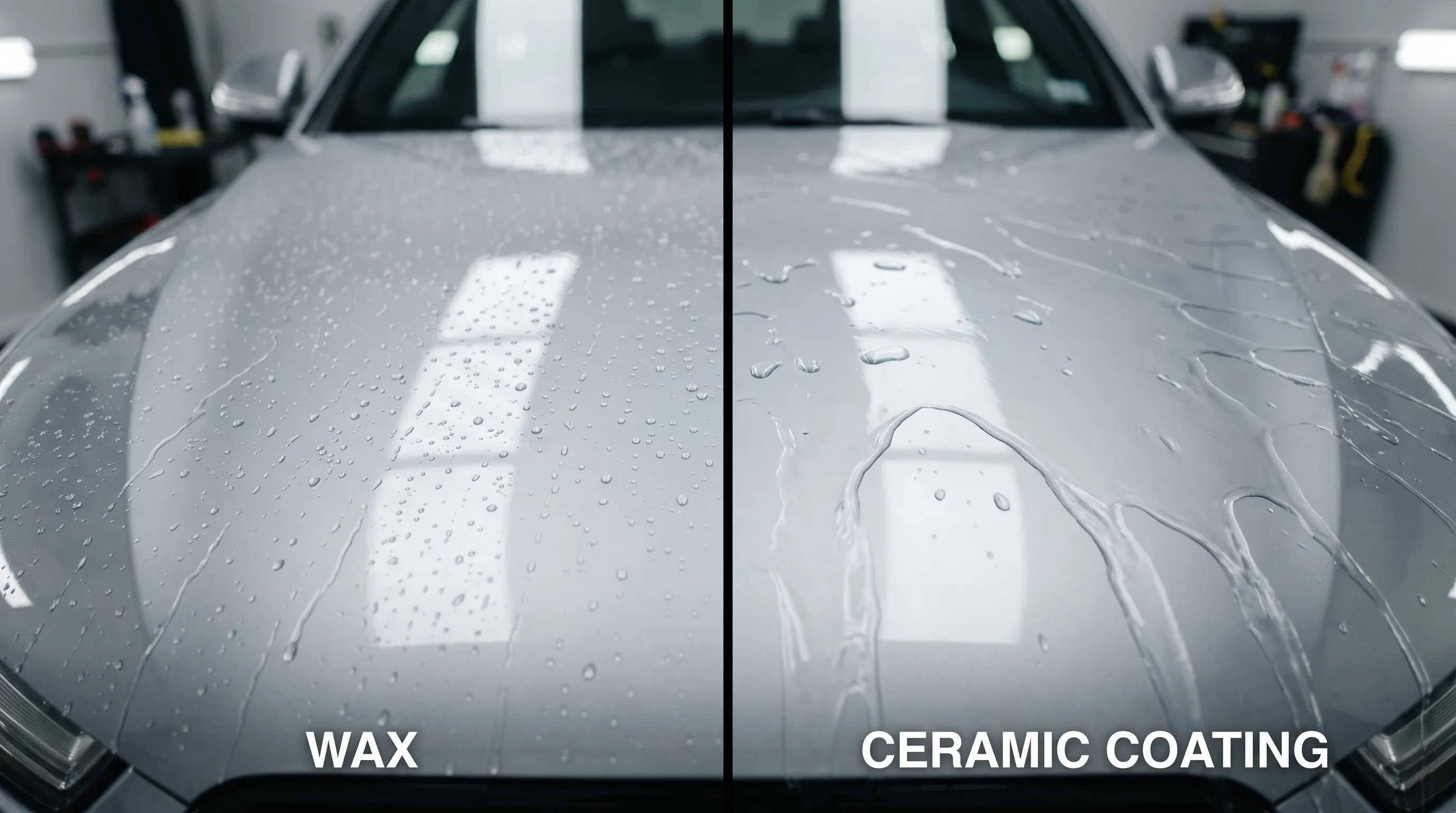
You can wax or ceramic coat over PPF, provided the product is compatible with polyurethane film and its functional top coat. A suitable wax adds short-term slickness and gloss, while a film-compatible ceramic coating can provide longer-lasting water repellency, stain resistance, and easier maintenance.
The order matters. PPF should be installed on properly prepared paint before wax or ceramic coating is applied. Placing a slick coating beneath the film can interfere with adhesive contact, edge stability, and long-term installation performance.
Can You Wax or Ceramic Coat Over PPF?
Modern PPF is designed to accept certain surface-protection products after the film has been installed and allowed to stabilize. That does not make every paint wax, polish, sealant, or ceramic coating safe.
The outermost layer of PPF is a thin functional top coat. Depending on the product, it controls gloss or satin texture, hydrophobic behavior, stain release, abrasion resistance, and recovery from shallow surface marks.
Any product applied over the film interacts with that top coat—not directly with the thicker TPU carrier beneath it. An incompatible chemical can create haze, uneven gloss, swelling, staining, reduced self-healing, or difficult residue around edges.
Start with the PPF manufacturer’s care instructions. Then verify that the wax or coating supplier specifically approves its product for polyurethane film, flexible surfaces, and the installed finish.
A ceramic coating labeled only for automotive clearcoat should not automatically be treated as a PPF coating. Paint clearcoat and flexible polyurethane film have different hardness, expansion, surface energy, and repair behavior.
Wax vs. Ceramic Coating on PPF
What Wax Adds
Wax creates a temporary sacrificial film over the PPF surface. It can increase slickness, deepen gloss, and make fresh contamination easier to release during washing.
Its main advantage is low commitment. Wax is relatively easy to apply and gradually wears away through washing, heat, detergents, and environmental exposure.
Traditional automotive wax commonly lasts from several weeks to a few months, depending on chemistry and vehicle use. It should be considered routine maintenance rather than a permanent additional layer.
Choose a nonabrasive, dye-free product approved for clear film. Avoid cleaner waxes containing polishing particles or rubbing compounds because abrasive material can alter the top coat and reduce surface quality.
Apply a thin layer. Heavy wax does not create proportionally stronger protection; it creates more residue around seams, badges, sensors, wrapped edges, and panel gaps.
Remove edge buildup with a clean lint-free towel rather than a sharp brush or aggressive solvent. Dried white residue around a clear-film edge can make an otherwise invisible installation obvious.
What Ceramic Coating Adds
A ceramic coating forms a more durable surface treatment than conventional wax. A suitable film coating can increase slickness, lower surface energy, improve water and dirt release, and provide another sacrificial layer against chemical contamination.
It does not add meaningful stone-chip protection. The PPF’s TPU thickness absorbs physical impact; the ceramic layer modifies the surface behavior above it.
A coating must also remain compatible with film flexibility. PPF stretches during installation and continues expanding and contracting with panel temperature after delivery.
A coating engineered for film should tolerate that movement without cracking, becoming cloudy, or interfering with self-healing. Products designed specifically for PPF and vinyl are the safer choice.
Ceramic coating can also make insects, road film, and mineral residue easier to remove. It cannot prevent all etching or water spotting, particularly when contaminated droplets are allowed to dry repeatedly on hot horizontal panels.
| Performance factor | Wax over PPF | Ceramic coating over PPF |
|---|---|---|
| Primary benefit | Short-term gloss and slickness | Longer-term water and contamination management |
| Typical durability | Weeks to several months | Months to several years, product-dependent |
| Application difficulty | Low | Higher; leveling and curing matter |
| Stone-chip protection | No meaningful increase | No meaningful increase |
| Removal or correction | Usually straightforward | May require controlled chemical or mechanical removal |
| Matte-film risk | Can create gloss or patchiness | Must be specifically approved for matte PPF |
The Correct PPF Layering Order
The correct sequence allows the PPF adhesive to contact clean paint and places the maintenance products on the exposed film surface where they belong.
- Inspect the paint, repaint history, chips, and existing protection products.
- Wash and chemically decontaminate the vehicle.
- Correct paint defects that would remain visible beneath the film.
- Remove wax, sealant, polishing oils, and existing ceramic coating from PPF coverage areas.
- Perform final surface preparation according to the film installation procedure.
- Install the PPF and complete the edge, moisture, and adhesion inspection.
- Allow the film to stabilize and installation moisture to evacuate.
- Prepare the exposed PPF surface for the approved wax or coating.
- Apply and level the surface product according to its instructions.
- Keep the vehicle dry and indoors for the specified coating cure period.
Do not install PPF over wax or ceramic coating. These products reduce surface energy, which is useful above the film but undesirable at the adhesive-to-paint interface.
A slick panel may allow the pattern to move easily during installation while preventing the adhesive from building the final bond required around edges, corners, sensors, and wrapped returns.
Existing ceramic coating should be professionally removed from every area receiving PPF. Partial removal can create inconsistent adhesion between polished and coated sections of the same panel.
There is no universal wait time before applying a surface product over newly installed film. Temperature, humidity, installation moisture, adhesive chemistry, panel geometry, and manufacturer instructions all affect stabilization.
A practical shop range is often 48–72 hours before applying a compatible coating, provided the film is dry and every edge is stable. Some care procedures specify waiting a full week before waxing, so the product-specific requirement takes priority.
Do not coat over cloudy installation moisture, fresh edge repairs, or an area that still needs to be lifted and reworked. Once a slick coating reaches the surface, tapes, temporary adhesives, and repair procedures may become less predictable.
After coating, follow the coating manufacturer’s cure instructions. Some flexible film coatings require the vehicle to remain dry and indoors for at least 12 hours after application.
Products You Should Never Apply Over PPF
A product described as “safe for automotive paint” is not automatically safe for PPF. Paint products may contain abrasives, solvents, dyes, oils, or gloss modifiers that behave differently on a polyurethane surface.
Avoid the following unless the film manufacturer gives explicit approval:
- Abrasive cleaner waxes and rubbing compounds
- Heavy-cut paint polishes
- Strong alkaline, acidic, or solvent-rich cleaners
- Waxes containing visible dyes or staining fillers
- Products intended to soften or swell paint contamination
- Unknown ceramic coatings with no PPF compatibility data
- Gloss-enhancing waxes or coatings on matte and satin film
- Oil-heavy dressings that can collect around edges
Do not polish PPF as though it were thick automotive clearcoat. The film may measure approximately 7.5 mil as a complete laminate, but the functional top coat occupies only a small portion of that construction.
Aggressive correction can permanently alter gloss, texture, hydrophobicity, and self-healing behavior before the technician realizes how much surface material has been removed.
Also avoid stacking several unrelated products simply because they are available. A wax applied over ceramic coating becomes the exposed surface, so its beading, dirt attraction, and durability can temporarily mask the coating beneath it.
More layers do not automatically produce better performance. Use the fewest compatible products required to achieve the maintenance behavior the customer wants.
Gloss, Matte, and Color PPF Need Different Care
Gloss PPF offers the widest compatibility with nonabrasive waxes and film coatings. A compatible product can increase slickness and deepen the reflected finish without changing the intended appearance dramatically.
Inspect dark gloss film carefully after coating. High spots, incomplete leveling, or oily residue appear quickly under linear detailing lights and direct sunlight.
Matte and satin PPF require stricter product selection. Their low-gloss appearance comes from controlled surface microtexture that scatters light.
Conventional wax can fill or partially smooth that texture, creating darker or glossier patches. Abrasive correction can permanently polish the film and cannot be reversed with a matte cleaner.
Use only products specifically approved for matte or satin protective film. Test them on a sample or hidden area and compare sheen under daylight and shop lighting before coating the complete vehicle.
Color PPF also requires a test section. A gloss-enhancing coating may deepen the shade, while some products can alter the appearance of metallic, pearl, or satin finishes.
The installer should show the customer the treated sample rather than assuming every visual change will be perceived as an improvement.
Layering Protection Across the Crystal Shell Range
All Crystal Shell films use a hydrophobic functional surface as part of their standard construction. A separate ceramic coating is therefore optional—not required to make the film repel water or release contamination.
The built-in top coat gives every Crystal Shell film a baseline of water repellency, stain resistance, easier maintenance, and controlled surface behavior. The mechanism is explained in the hydrophobic PPF guide.
Crystal Premium Clear Bra
Crystal Premium Clear Bra can receive a compatible nonabrasive wax or PPF-specific ceramic coating after the installation has stabilized.
Wax is suitable when the owner wants a short-term gloss and slickness boost. A flexible ceramic coating is the stronger option when the goal is longer-lasting water release and easier cleaning.
Neither product replaces the film’s aliphatic TPU barrier. The wax or coating manages the outer surface; Crystal Premium Clear Bra remains responsible for absorbing gravel impact and physical abrasion.
Crystal Satin Stealth
Crystal Satin Stealth should receive only products confirmed for matte or satin polyurethane film. Conventional wax and gloss coatings can change the intended sheen or create uneven dark areas.
Because the film already uses a hydrophobic top coat, additional treatment should be selected for a specific maintenance reason rather than applied automatically to every satin installation.
Crystal Color Infused PPF
Crystal Color Infused PPF combines a broad range of colors and shades with a hydrophobic protective surface. An additional coating may increase slickness, but the installer must verify that it does not alter the selected color, metallic effect, or finish.
Apply the product to a curved sample panel first. Evaluate it under daylight, diffused workshop light, and linear LED inspection lighting before treating the entire vehicle.
Crystal Shell’s complete film and top-coat architecture is described on the Crystal Shell technology platform. Clean application equipment from Crystal Shell Precision Install Tools also helps prevent residue, high spots, and contamination during final surface preparation.
How to Coat Existing PPF
Older PPF can be ceramic coated when the film remains clear, attached, and structurally sound. Coating will not repair yellowing, cracked top coat, deep staining, punctures, edge lift, or adhesive failure.
Begin with a controlled inspection and preparation process:
- Inspect every edge, seam, corner, and high-stretch area.
- Wash the film using a pH-appropriate shampoo.
- Remove iron contamination, road film, insects, tar, and minerals with PPF-safe chemistry.
- Rinse and dry the film completely.
- Perform a compatibility test with the coating preparation product.
- Repair or replace unstable PPF before coating.
- Apply the coating in small sections and inspect for high spots.
Do not use coating as a way to hide failed film. Added gloss may temporarily reduce the visibility of fine haze, but it cannot restore degraded polymer or unstable adhesive.
If the film has lost hydrophobicity, decontaminate it before assuming the top coat has failed. Mineral residue, detergent film, oils, and traffic contamination can mask water behavior while the functional surface remains underneath.
The relationship between the two systems is covered in the ceramic coating vs. PPF guide.
Conclusion: Add Only What the Film Actually Needs
Wax and ceramic coating can both be applied over PPF when the products match the film, finish, and maintenance objective. Wax provides a temporary visual and tactile boost; ceramic coating offers a more durable surface treatment.
The correct order is paint preparation, PPF installation, film stabilization, then compatible surface protection. Never install PPF over untreated wax or ceramic coating, and never use abrasive products as routine film maintenance.
Every Crystal Shell film already includes hydrophobic surface technology. Add wax or ceramic coating only when it creates a measurable benefit beyond that built-in performance.
Review Crystal Premium Clear Bra, Crystal Satin Stealth, and Crystal Color Infused PPF, or contact Crystal Shell for product-specific layering and maintenance guidance.