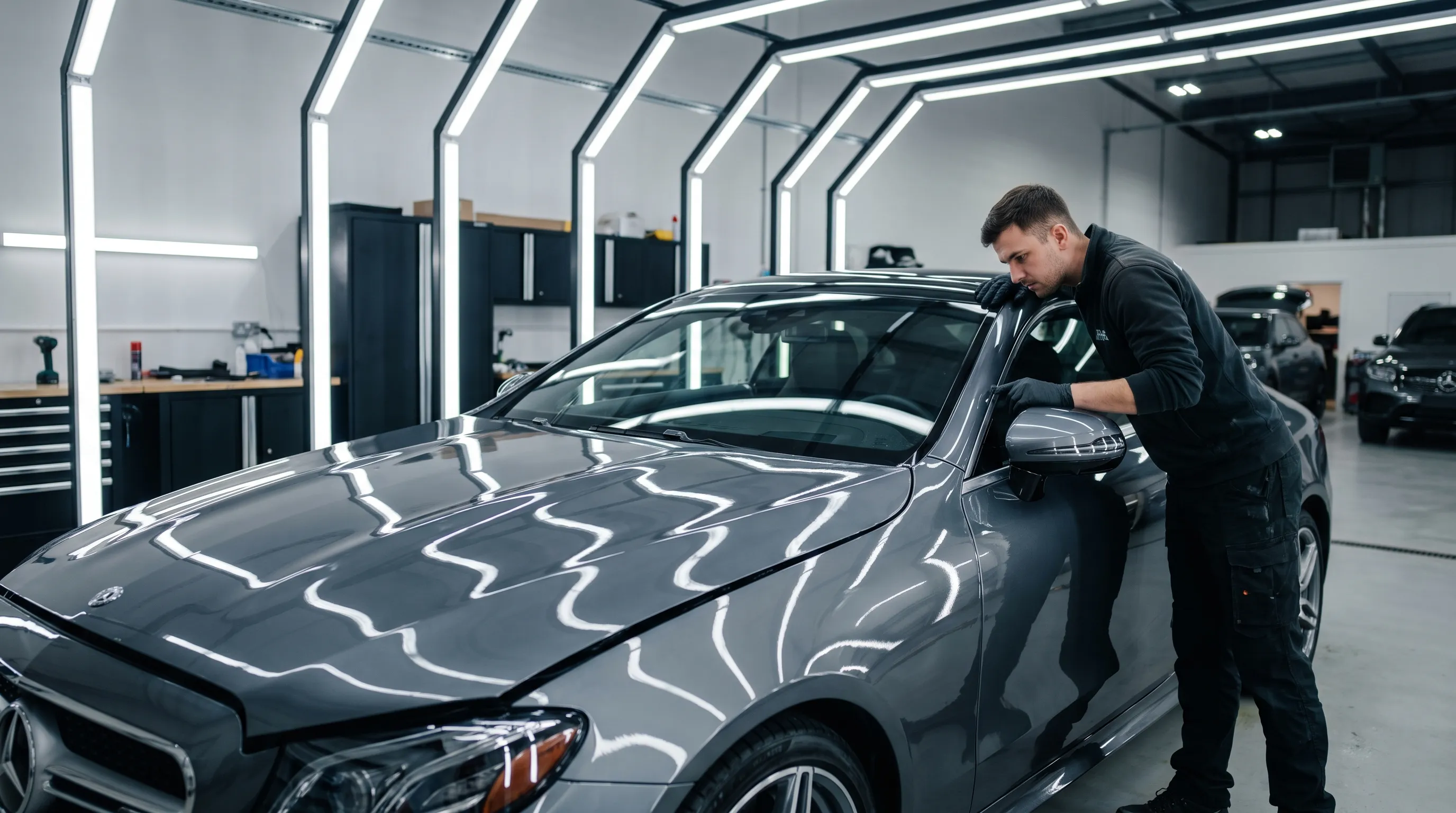
Ceramic coating vs. PPF is not a comparison between two versions of the same product. Paint protection film absorbs physical impact with a flexible polyurethane barrier, while ceramic coating changes the surface chemistry to improve cleaning, gloss retention, and resistance to environmental contamination.
A ceramic coating cannot stop highway stone chips. PPF cannot make a vehicle maintenance-free. Choosing correctly starts by identifying the damage you are trying to prevent rather than buying the product with the loudest hardness, gloss, or warranty claim.
What Is the Difference Between Ceramic Coating and PPF?
Ceramic coating is a liquid-applied product that cures into a thin, crosslinked layer over automotive clearcoat. Most professional systems use organosilicon chemistry, including silanes or siloxanes, to create a surface with lower surface energy than untreated paint.
The cured layer is commonly measured in microns rather than mils. One major coating manufacturer describes its coatings as approximately 1 micron thick. Actual deposited thickness varies with the formulation, solids content, application rate, leveling process, and number of layers.
Paint protection film is a physical laminate. A modern PPF construction normally includes a functional top coat, an aliphatic thermoplastic polyurethane carrier, and a pressure-sensitive acrylic adhesive.
Common automotive films measure approximately 150–200 microns, or about 6–8 mil, after installation. A 7.5 mil film is 190.5 microns thick, making it roughly 190 times thicker than a nominal 1-micron coating.
That thickness difference explains the basic division of labor. A coating can resist chemical bonding, reduce dirt adhesion, and make washing easier. PPF has enough flexible material to deform under gravel, scraping, and incidental contact before those forces reach the clearcoat.
Neither system is invisible in every condition. Coatings can leave high spots when poorly leveled, while low-quality PPF can introduce haze, texture, adhesive marks, or visible edges. Preparation and installation quality matter as much as the product label.
How Ceramic Coating and PPF Work
Ceramic Coating Controls Surface Chemistry
A cured ceramic coating creates a harder, lower-energy surface over the paint. Water tends to form tighter beads, oily contamination has less direct contact with the clearcoat, and routine dirt can require less mechanical force to remove.
That reduced cleaning force matters because most daily-driver swirl damage occurs during washing and drying. A coating does not make the paint impossible to scratch, but it can reduce the frequency and severity of micro-marring when combined with proper wash media and technique.
Chemical resistance is another practical advantage. Bird droppings, insect residue, tree sap, road film, and alkaline or acidic contamination contact the coating before they contact the clearcoat.
The coating is sacrificial, not chemically invincible. Bird residue left under heat for several days can still etch the coating, and a severe spot may require polishing and reapplication. Hydrophobic behavior also declines when mineral deposits, traffic film, or detergent residue cover the surface.
Water beading alone does not prove that the base coating has failed or survived. A contaminated coating may stop beading even while part of the cured layer remains. Decontamination is therefore a diagnostic step before declaring the product dead.
Coating performance should not be judged by the advertised SiO2 percentage alone. There is no universal calculation connecting a higher stated percentage to better hardness, water behavior, chemical resistance, or service life. The complete resin system and curing behavior control the result.
PPF Absorbs Physical Impact
PPF protects through thickness, elasticity, and controlled deformation. When a piece of gravel strikes the front bumper, the polyurethane stretches and distributes part of the impact over a wider area instead of allowing the object to contact the clearcoat directly.
Modern aliphatic TPU can combine high elongation at break with optical clarity and outdoor stability. The aliphatic structure is selected because it resists UV-driven yellowing better than aromatic polyurethane, but the stabilizer package and top-coat quality still determine long-term appearance.
Most visible self-healing occurs in the film's surface region. Fine wash marks can relax when heat increases polymer-chain mobility and allows reversible intermolecular interactions to reform. A cut that removes material, punctures the TPU, or exposes paint cannot regenerate.
PPF also protects against door-edge contact, loading scratches, light parking abrasions, and staining that would otherwise reach the paint. Coverage determines the result: an unprotected rear quarter panel receives no benefit from film installed on the front bumper.
For a deeper explanation of chain mobility and scratch recovery, read the molecular science behind self-healing TPU.
Ceramic Coating vs. PPF: Head-to-Head Comparison
The practical comparison is not which product is universally better. It is which failure mode each product can realistically control.
| Protection factor | Ceramic coating | Paint protection film |
|---|---|---|
| Stone chips | Minimal meaningful protection | Primary protection function |
| Deep scratches | Limited resistance | Can absorb or reduce minor contact damage |
| Fine wash marring | Improves resistance and reduces cleaning friction | Top coat may self-heal shallow marks |
| Bird droppings and insects | Sacrificial chemical barrier | Physical barrier with product-dependent stain resistance |
| Water behavior | Usually stronger initial hydrophobic performance | Depends on the PPF top coat |
| Gloss enhancement | Can increase clarity, slickness, and perceived depth | Can preserve or alter texture depending on film quality |
| Damage repair | Polish or remove and reapply the coating | Replace the affected film panel or section |
| Typical installed thickness | Approximately 1–3 microns, product-dependent | Approximately 150–200 microns for common automotive films |
| Installation time | Typically 1–3 shop days including preparation and curing | About 1–2 days for a full front and 3–5 days for full-body coverage |
| Relative installation cost | Lower material and installation labor | Higher material cost and substantially more installation labor |
PPF usually costs more because the installer must pattern, position, stretch, squeegee, trim, wrap, and inspect individual panels. Full-body installation may require several days, controlled disassembly, edge preparation, and correction of installation defects before delivery.
Ceramic coating uses less material but can still require substantial preparation. If the paint needs 10–20 hours of correction before coating, the invoice is paying for defect removal and surface preparation rather than the liquid inside the bottle.
The Truth About 9H Hardness
A "9H ceramic coating" claim usually refers to pencil hardness, not the Mohs mineral-hardness scale. ASTM D3363 uses drawing leads of known hardness to rank the relative hardness of organic coating films under controlled conditions.
The test is useful for comparing coatings when the substrate, film thickness, cure, pencils, and procedure remain consistent. ASTM also warns that results can vary between laboratories, pencil manufacturers, pencil batches, and substrates.
A 9H result does not mean the coating is nearly as hard as corundum, cannot be scratched by a key, or can stop a rock. Pencil hardness and impact absorption measure different material behavior.
A thin hard layer may resist light abrasion but cannot dissipate the kinetic energy of road debris like a 150–200 micron elastomeric film. Any seller using 9H as proof of stone-chip resistance is mixing unrelated tests.
Which Protection Should You Choose?
Match the System to Your Driving Exposure
Choose PPF first when impact damage is the dominant risk. Highway commuters, track-day drivers, off-road vehicles, low sports cars, and vehicles covering more than 10,000–15,000 miles per year receive repeated exposure at the bumper, hood, mirrors, rocker panels, and rear wheel arches.
A full-front package normally covers the bumper, complete hood, complete front fenders, and mirror caps. This avoids a visible seam across the hood and protects the panels that receive the highest concentration of forward-facing impacts.
Consider Crystal Premium Clear Bra when maintaining the factory gloss finish is the priority. Owners seeking a satin conversion should compare it with Crystal Satin Stealth and review matte vs. gloss PPF before selecting a finish.
Choose ceramic coating first when cleaning behavior, gloss retention, and environmental resistance are the main priorities. This can be the rational option for an urban vehicle with limited highway exposure, a regularly maintained garage car, or an owner whose budget does not support meaningful PPF coverage.
A coating is also useful on panels that are not covered with PPF. Applying PPF to the full front and coating the remaining paint provides targeted impact protection without the cost of wrapping every body panel.
Full-body PPF makes sense when repaint risk carries a high financial or emotional cost. Rare factory paint, expensive multi-stage finishes, collector vehicles, track cars, and vehicles used in harsh road conditions have more to gain from complete physical coverage.
It is less rational to spend heavily on full-body film if the vehicle already has unstable repaint work. Film removal can expose weak adhesion between aftermarket paint layers. Repainted panels should be inspected for cure, edge quality, film build, and adhesion before installation.
Common Buying Mistakes
The first mistake is asking which product is "best" without defining the threat. A coating wins at reducing dirt adhesion. PPF wins against stone impact. Neither fact cancels the other.
The second mistake is buying a coating as a substitute for paint correction. A coating locks in the appearance beneath it. Swirls, sanding haze, water-spot etching, and rotary holograms remain visible unless corrected before application.
The third mistake is assuming PPF eliminates maintenance. Road film, insect residue, mineral deposits, oils, and dye can still contaminate the top coat. Film should be washed regularly and inspected around edges, seams, vents, and high-stretch areas.
The fourth mistake is choosing the longest warranty without reading the exclusions. Warranty duration does not identify the covered failure, acceptable yellowing threshold, hydrophobicity requirement, labor reimbursement, or installer responsibility.
The fifth mistake is protecting low-risk panels while leaving the impact zones exposed. Coating the whole vehicle and adding PPF only to the door cups may look comprehensive on an invoice, but it does little for a bumper receiving highway gravel.
Can You Apply Ceramic Coating Over PPF?
Yes, a compatible ceramic coating can be applied over cured PPF. The combination assigns a different job to each layer: TPU manages physical impact, while the coating improves surface slickness, water behavior, and resistance to contamination.
The coating must be approved for flexible polyurethane film. A formula designed only for hard automotive clearcoat may produce inconsistent adhesion, alter the film's self-healing response, create uneven gloss, or become difficult to remove without damaging the top coat.
Do not apply a conventional ceramic coating to the painted panel before installing PPF unless the film manufacturer specifically approves that process. The PPF adhesive is engineered to contact properly prepared paint, not an unknown low-energy coating layer.
Installing film over an incompatible coating can reduce initial tack, promote edge lift, complicate positioning, or make adhesion inconsistent across polished and coated sections. Existing coatings should normally be removed from PPF coverage areas during paint correction and surface preparation.
The Correct Installation Sequence
- Inspect the paint, repaint history, panel edges, chips, and existing coatings.
- Wash, chemically decontaminate, and mechanically decontaminate where required.
- Correct defects that would remain visible beneath the film.
- Remove polishing oils and incompatible coating residue from PPF coverage areas.
- Install the PPF and complete the required edge, seam, and moisture inspection.
- Allow the film and adhesive to stabilize according to product and shop conditions.
- Apply a film-compatible coating to the PPF and a paint coating to exposed panels.
- Keep the vehicle dry for the coating manufacturer's specified initial cure period.
A practical stabilization period before coating PPF is often 24–72 hours, depending on temperature, humidity, installation moisture, film construction, and adhesive behavior. Trapping installation solution beneath a coating does not improve the result.
The installer should recheck edges before coating. Once a slick coating has been applied, additional edge work becomes more difficult because tapes, adhesives, and repositioning procedures may no longer behave predictably.
Installation quality also depends on clean squeegee edges, consistent solution ratios, safe trimming, and controlled heat. Precision Install Tools are designed for repeatable film handling rather than improvised pressure and blade control.
Maintenance After Installation
Wait for the specified cure period before the first wash. Depending on the coating system, that may mean avoiding water for roughly 12–24 hours and avoiding detergents for several days.
Use pH-neutral shampoo, clean wash media, and low-pressure drying methods. A ceramic coating reduces the force required to clean a vehicle, but an automatic brush wash can still abrade the coating and mark the PPF.
Remove bird droppings, insect residue, fuel spills, and tree sap quickly. Hydrophobicity slows contamination bonding; it does not make corrosive residue harmless under summer surface temperatures that can exceed 60°C.
Inspect the vehicle every 6–12 months. Check PPF edges, surface contamination, water behavior, mineral deposits, stain retention, and panels that have received body-shop work.
If water behavior declines, perform a controlled decontamination before adding a booster product. Stacking sealants over traffic film can temporarily improve beading while leaving the underlying contamination in place.
Conclusion: Build the Protection System Around the Risk
Ceramic coating and PPF solve different engineering problems. A micron-scale coating improves surface chemistry, cleaning, gloss retention, and resistance to environmental contamination. A 150–200 micron polyurethane film provides the physical thickness and elasticity required to reduce stone chips and contact damage.
Choose ceramic coating when maintenance and chemical exposure are the main concerns. Choose PPF when impact is the main concern. Use both when the vehicle faces both forms of damage and the budget supports a properly installed system.
Start with the panels most likely to require repainting after damage: the bumper, hood, fenders, mirrors, rockers, and rear impact zones. Review the Crystal Shell protection technology, compare Crystal Premium Clear Bra, or contact Crystal Shell to define the correct coverage and surface treatment for your vehicle.