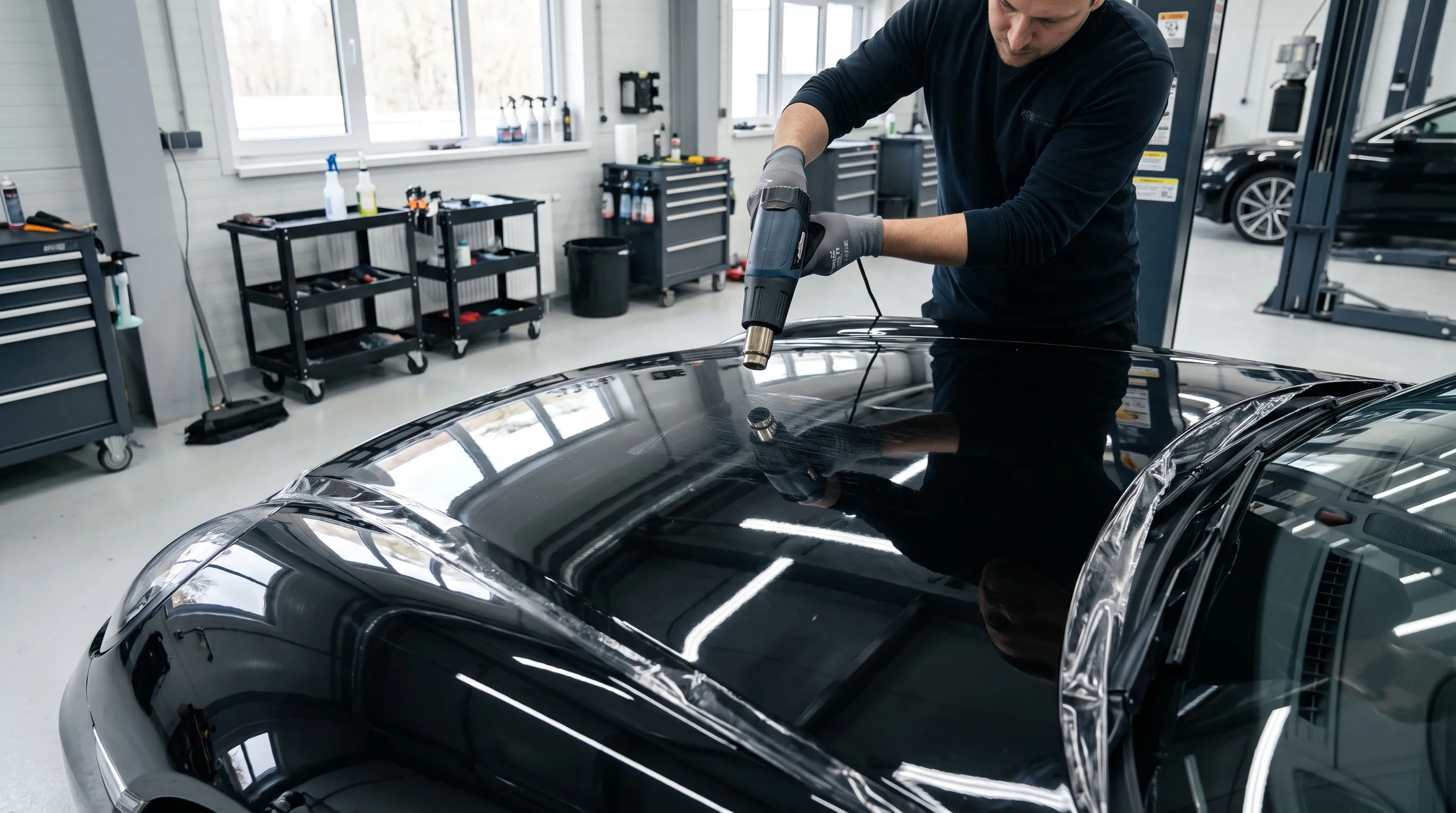
Self-healing TPU does not regenerate like skin. In paint protection film, shallow scratches disappear because flexible polymer chains in the surface layer regain mobility, relax toward their original shape, and rebuild reversible intermolecular interactions. That distinction matters: a wash-induced swirl may vanish, while a cut that removes polymer will remain.
What Is Self-Healing TPU in Paint Protection Film?
Thermoplastic polyurethane is a segmented elastomer, not a single uniform plastic. Its molecular backbone contains flexible soft segments and more rigid hard segments. The soft phase supplies stretch and recovery; the hard phase acts like a network of physical anchors that keeps the film from flowing out of shape.
Automotive PPF is also a multilayer system. A typical construction includes a polyurethane clearcoat or functional top coat, a TPU carrier film, an acrylic pressure-sensitive adhesive, and a release liner used only during installation. Published commercial specifications commonly place the installed film and adhesive near 7.5 mil, or 0.19 mm, but total thickness alone says little about healing performance.
The phrase "self-healing TPU" is therefore convenient but incomplete. Most visible scratch recovery happens at the outer clearcoat or top-coat region, while the thicker TPU layer supplies impact absorption, elongation, and conformability. A film can use a strong TPU base and still have a weak, stain-prone, or slow-healing surface.
How the Molecular Self-Healing Process Works
Soft Segments Provide Mobility
The soft segments are commonly built from polyether, polyester, or polycaprolactone polyols. At service temperatures, these regions remain flexible enough for local chain movement. When a shallow scratch pushes material aside rather than cutting it away, that mobility gives the surface a path back toward its lower-energy shape.
Hard Segments Provide Elastic Memory
Hard segments form from diisocyanates and short-chain extenders. They cluster into microscopic domains and behave as reversible physical crosslinks. Those domains resist permanent flow, so the displaced soft phase is pulled back instead of staying as a groove.
Hydrogen Bonds Break and Reform
Urethane groups contain N–H donors and carbonyl acceptors that form hydrogen bonds between neighboring chains. Stress disrupts part of that network. As the chains move back into contact, the bonds can form again, restoring cohesion across a deformed region.
Heat accelerates the process by increasing segmental mobility and reducing the time required for viscoelastic relaxation. The film is not melting during normal scratch recovery. Aliphatic TPU grades used for film processing may require extrusion temperatures around 175–185°C, far above the controlled warmth used to speed surface recovery on a vehicle.
Three forces therefore work together: elastic recoil from the network, molecular diffusion within the soft phase, and reformation of reversible intermolecular bonds. Surface tension helps smooth the final optical interface. What the eye sees as "healed" is usually a reduction in groove depth and light scattering, not the creation of new polymer.
What Self-Healing TPU Can and Cannot Repair
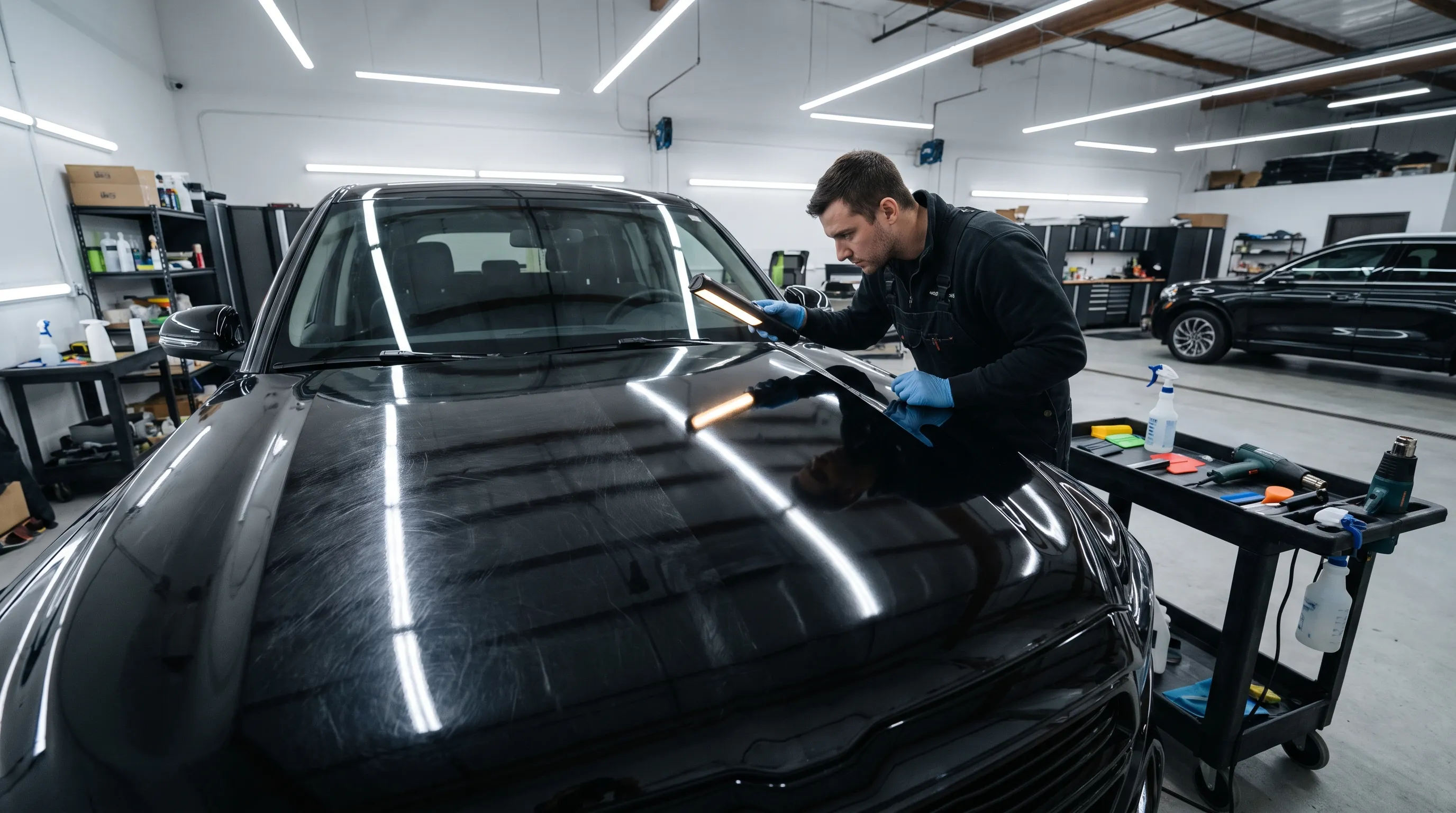
The fastest way to expose weak marketing is to ask whether material was displaced or removed. Self-healing works best on elastic deformation confined to the surface layer. Once a blade, stone, or abrasive cuts through that layer, the missing volume has nowhere to come from.
| Damage type | Likely result | Reason |
|---|---|---|
| Light wash marring and fine swirls | Often strong visual recovery | The mark is usually shallow and dominated by surface displacement. |
| Soft brush or fingernail marks | Partial to full recovery | Recovery depends on load, tip geometry, top-coat thickness, and temperature. |
| Deep scratch with raised or whitened edges | Partial recovery at best | Strain whitening, tearing, or permanent plastic deformation may have occurred. |
| Stone chip exposing paint | No self-healing | The film has been punctured and material may be missing. |
| Chemical etching, dye transfer, or yellowing | No reliable recovery | These are chemical or optical changes, not a temporary mechanical groove. |
| Edge lift, silvering, or adhesive failure | No self-healing | The failure is in the adhesive interface rather than the surface polymer. |
A useful rule is blunt: if you can catch the defect sharply with a fingernail, do not promise complete healing. Controlled warmth may soften the appearance, but it cannot rebuild a severed top coat. Installers should set that expectation before delivery, not after a customer returns with a rock strike.
Why Fast Healing Is Not Automatically Better
Polymer design is a trade-off. A softer network allows chains to move quickly, which can make a fresh sample heal impressively under a heat lamp. The same softness may increase dirt pickup, pressure marking, solvent swelling, edge imprinting, and loss of gloss after repeated washing.
A harder or more densely crosslinked top coat resists scratching and chemical attack, but chain mobility drops. Healing becomes slower, requires more heat, or stops before the groove fully levels. Excessive surface hardness can also create microcracking when the installer stretches film over a mirror cap or deep bumper recess.
That is why scratch resistance and self-healing are different properties. Scratch resistance measures how difficult it is to create damage. Self-healing measures how much of the damage disappears afterward. A credible data sheet should separate the two instead of presenting one dramatic key-scratch video.
Hydrophobicity is another separate property. A low-surface-energy top coat can improve water beading and reduce contamination, but a high contact angle does not prove molecular recovery. Adding a ceramic coating may change slickness and maintenance behavior, yet it does not replace the impact-absorbing TPU layer or create new polymer inside a cut. The practical differences are covered in ceramic coating vs. PPF.
How Heat, Time, and Aging Change Scratch Recovery
Some films recover fine marks at room temperature over several hours. Others respond faster when warmed by sunlight, warm water, or controlled shop heat. There is no universal activation temperature because top-coat chemistry, crosslink density, film age, scratch depth, and ambient conditions all change the result.
Published commercial PPF data shows why one number cannot describe the whole system. Films near 7.5 mil total thickness may report elongation at break from roughly 350% to 400% and tensile strength from about 17 to 22 MPa. Those values describe the construction’s ability to stretch and carry load; they do not prove that its outermost microns will recover a scratch after five years outdoors.
UV exposure, oxidation, road-film contamination, repeated detergents, and thermal cycling can reduce molecular mobility or alter surface chemistry. Aliphatic polyurethane is selected for outdoor optical stability because it resists yellowing better than aromatic polyurethane, but "aliphatic" is not a complete durability specification. Stabilizer package, top-coat chemistry, extrusion quality, adhesive compatibility, and weathering validation still decide service life.
A heat gun can accelerate recovery, but uncontrolled heat is a poor diagnostic tool. A concentrated nozzle can distort gloss, overstretch an edge, or stress the adhesive before the operator realizes how hot the surface has become. Use an infrared thermometer, keep the heat source moving, and follow the film manufacturer’s service limits rather than chasing a social-media demonstration.
How to Evaluate Self-Healing PPF Before Installation
For car owners, ask for construction and test data, not only warranty length. For installers, test the film after conditioning and aging, not only five minutes after removing it from the box. Fresh polymer is often more mobile than film that has spent years under UV, detergent, and heat.
A Practical Controlled Shop Test
- Condition every sample for 24 hours at the same room temperature.
- Create scratches with the same tip, load, stroke length, and number of passes.
- Photograph the surface under fixed lighting immediately, after 30 minutes, and after 24 hours.
- Warm a second matched area to a controlled 50°C for 10 minutes, then record the same intervals.
- Repeat the cycle at least 20 times on the same zone to expose fatigue or gloss loss.
- Measure 60-degree gloss and haze when possible; visual inspection alone hides small optical losses.
Then repeat the comparison after accelerated UV exposure, detergent cycling, and a stain challenge. A film that heals quickly but retains dye, loses gloss, or becomes tacky is not a balanced premium surface. The useful target is repeatable recovery without sacrificing optical clarity, chemical resistance, or installation behavior.
Also separate top-coat performance from base-film performance. A published elongation value of 400% may help explain conformability, but it does not tell you how the clearcoat behaves at 120% local stretch on a bumper corner. Installers should examine gloss shift, texture change, and edge tension after forming, using clean squeegees and controlled technique from Precision Install Tools.
For a closer look at film architecture and surface engineering, review the Crystal Shell technology platform and compare the construction goals of Crystal Premium Clear Bra. The deeper polymer explanation continues in ceramic coating vs. PPF.
Conclusion: Judge the Recovery, Not the Claim
Self-healing TPU works because a segmented polyurethane network can move, recoil, and rebuild reversible interactions after shallow deformation. It is an engineered balance between mobility and restraint, not a biological repair process and not permission to ignore deep damage.
Use one decision rule: demand controlled before-and-after testing that includes heat, time, repeated scratching, and aged film. Then match the product to the vehicle, finish, and installation geometry. Start with Crystal Premium Clear Bra or contact Crystal Shell for application guidance.