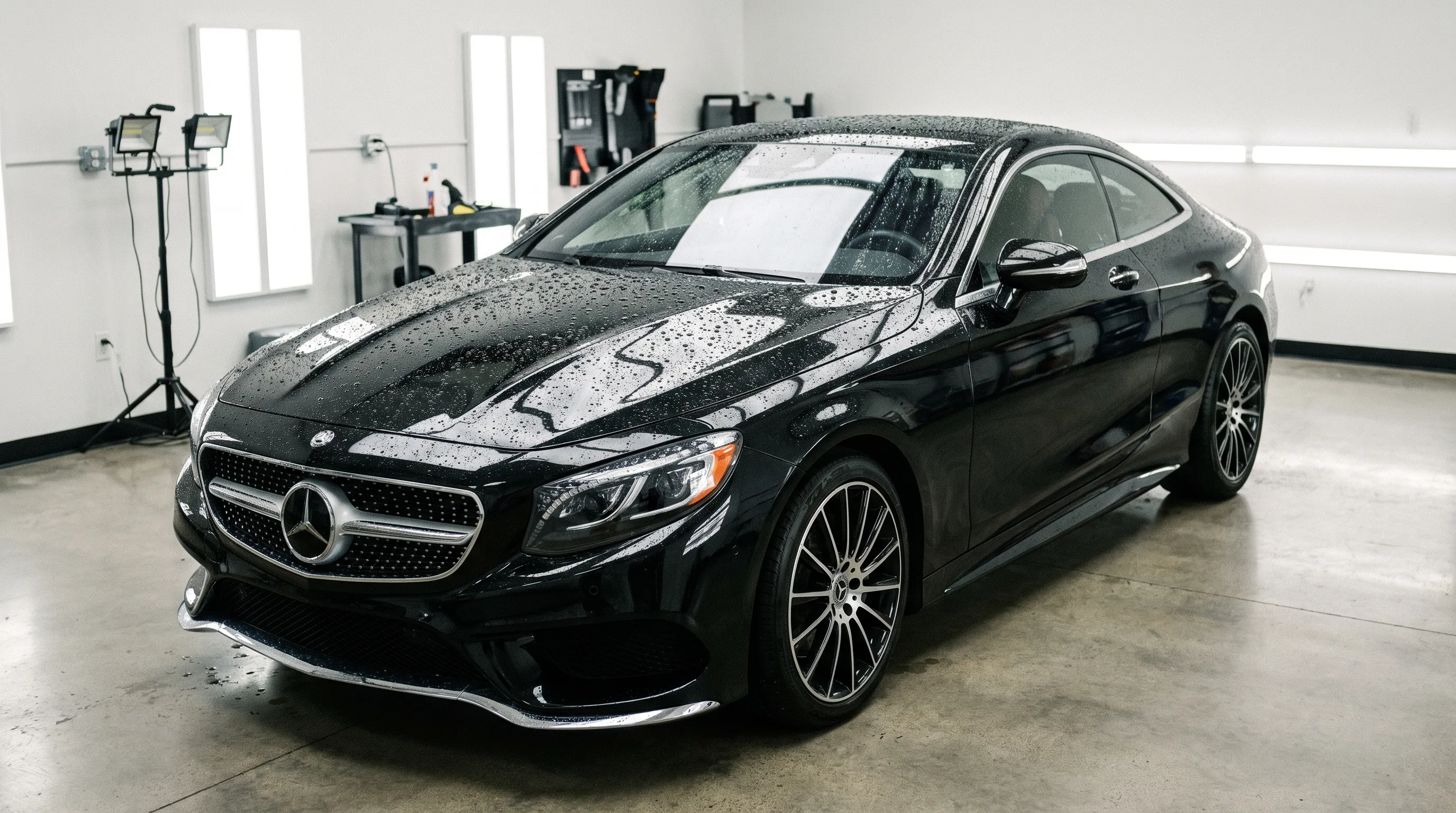
Hydrophobic PPF is paint protection film with a low-surface-energy top coat that causes water to bead instead of spreading across the panel. The same surface can reduce the adhesion of road film, insects, oils, and mineral residue, making the protected vehicle easier to wash.
“Self-cleaning” does not mean maintenance-free. Rain may carry loose dust from a clean panel, but it cannot reliably remove traffic film, dried insects, road salt, grease, or hard-water deposits. Hydrophobic PPF reduces cleaning effort; it does not eliminate cleaning.
What Is Hydrophobic PPF?
Modern PPF is a multilayer laminate. A typical construction contains a functional top coat, an aliphatic TPU carrier, and an optically clear pressure-sensitive adhesive.
The thick TPU layer provides impact absorption, elongation, and conformability. Hydrophobic behavior comes primarily from the chemistry of the outer top coat—not from film thickness or the TPU carrier alone.
The top coat is engineered to reduce surface energy. Water has less attraction to the protected surface, so it contracts into rounded droplets instead of forming a flat sheet.
A water contact angle above approximately 90 degrees is generally described as hydrophobic. A higher angle usually produces tighter beads, but the largest number does not automatically identify the easiest surface to maintain.
Water must also release from the panel. A tall droplet that remains pinned in place can dry and leave a mineral ring, while a slightly lower contact angle combined with low sliding resistance may evacuate water more effectively.
This is why a slow-motion beading video is not a complete PPF test. Contact angle, sliding angle, surface contamination, abrasion resistance, chemical stability, and performance after aging all matter.
How a Hydrophobic PPF Top Coat Works
Contact Angle Is Only Part of the Measurement
Contact angle measures the geometry of a liquid droplet resting on a surface. A flatter droplet indicates stronger wetting, while a rounded droplet indicates lower interaction between the water and the surface.
Installers should also examine contact-angle hysteresis—the difference between the angle at the advancing and receding sides of a moving droplet. Lower hysteresis generally allows water to move with less resistance.
The practical shop measurement is roll-off behavior. Place the test panel at a controlled angle and record when a defined amount of water begins moving. Repeat the test before and after detergent cycles, abrasion, heat, and outdoor aging.
A film that produces dramatic beads when new but loses water release after several washes has a weak functional surface. Premium hydrophobicity must survive use rather than exist only for the delivery video.
Why Water Carries Some Dirt Away
Loose particles can attach more strongly to a moving droplet than to a low-energy surface. As water rolls away, it can collect part of that dust and carry it from the panel.
This effect works best on lightly contaminated, steep, or curved surfaces. A vertical door can release water and loose dust more easily than a horizontal roof where droplets remain stationary and evaporate.
Bonded contamination behaves differently. Oily traffic film, insect proteins, tree sap, iron particles, and dried minerals may chemically or mechanically attach to the top coat.
Rain does not provide the detergent chemistry or controlled mechanical action needed to remove those deposits. Calling hydrophobic PPF “self-cleaning” is useful shorthand, but interpreting the term literally creates poor maintenance habits.
What Self-Cleaning PPF Can and Cannot Do
| Condition | What hydrophobic PPF can do | What it cannot guarantee |
|---|---|---|
| Rain and rinse water | Promote beading and faster water release | Prevent every dried water spot |
| Loose dust | Allow some particles to leave with moving water | Clean a heavily dusty vehicle without washing |
| Road film | Reduce direct bonding and cleaning effort | Remove oily contamination with water alone |
| Insects and bird residue | Provide a sacrificial, easier-to-clean surface | Prevent etching after prolonged heat exposure |
| Mineral deposits | Reduce broad water sheeting | Stop minerals from remaining when droplets dry |
| Stone chips | The underlying TPU absorbs part of the impact | Use hydrophobicity itself as impact protection |
| Wash marring | Reduce friction and cleaning pressure | Make poor wash technique harmless |
Hydrophobicity should not be confused with self-healing. A surface can repel water without repairing shallow scratches, and a self-healing polymer can recover marks without producing strong water beading.
Premium PPF often combines both functions in one top coat. The mechanisms remain separate: low surface energy controls wetting, while polymer mobility and reversible interactions control scratch recovery.
The recovery mechanism is explained in the molecular science behind self-healing TPU.
Hydrophobicity is also different from film thickness. A 7.5 mil laminate may provide a useful physical impact barrier, but its water behavior depends on the exposed surface chemistry.
How Hydrophobic PPF Changes Vehicle Maintenance
The main benefit is lower cleaning resistance. Dirt releases with less scrubbing, drying becomes faster, and the technician or owner needs fewer aggressive passes across the protected surface.
Reduced mechanical contact lowers the opportunity for wash-induced marring. It does not remove that opportunity. Dirty towels, automatic brushes, contaminated wash mitts, and excessive pressure can still mark the top coat.
Wash a protected vehicle when visible road film develops rather than waiting for water beading to disappear completely. Hydrophobic performance can become temporarily masked by detergent residue, minerals, oils, or traffic film.
A decline in beading does not automatically mean the top coat has failed. Begin with a controlled wash and chemical decontamination using products approved for PPF.
If water behavior returns, the functional surface was contaminated. If it remains weak after safe decontamination, abrasion or chemical aging may have changed the top coat.
Use the following maintenance routine:
- Rinse loose grit before touching the vehicle.
- Use a pH-appropriate automotive shampoo.
- Wash with clean, soft media and straight controlled passes.
- Remove insect residue, bird droppings, fuel, and tree sap promptly.
- Dry remaining beads before mineral-rich water evaporates.
- Avoid unidentified solvents, abrasive compounds, and gloss enhancers.
- Inspect edges and high-impact areas every one to two weeks.
A compatible ceramic coating can increase slickness or alter water behavior, but it is not required for PPF to be hydrophobic. Applying the wrong product can also change matte sheen, interfere with future repairs, or create uneven performance.
The distinction between the two systems is covered in the ceramic coating vs. PPF guide.
Hydrophobic Protection Across the Crystal Shell Line
Every film in the Crystal Shell product range uses a hydrophobic functional surface. Hydrophobicity is not limited to one premium upgrade or one clear-film model; it is part of the standard surface architecture across the lineup.
Crystal Shell combines advanced aliphatic TPU technology developed by Lubrizol with product-specific top coats. The TPU provides the structural protection, while the hydrophobic surface controls water interaction, contamination release, and maintenance behavior.
Crystal Premium Clear Bra
Crystal Premium Clear Bra uses a hydrophobic gloss top coat to preserve paint depth while reducing water sheeting and contamination adhesion. It is designed for owners who want physical protection without changing the factory finish.
On dark paint, efficient water release is particularly useful because dust, wash residue, and mineral rings create strong visual contrast. The surface still needs drying when hard water remains on horizontal panels.
Crystal Satin Stealth and Color Infused PPF
Crystal Satin Stealth combines hydrophobicity with a controlled satin texture. Its surface must release contamination without becoming glossy or producing uneven dark patches during cleaning.
Use matte-compatible products only. Abrasive polishing or gloss-enhancing sealants can flatten the microtexture and create a permanent bright area even when the underlying TPU remains intact.
Crystal Color Infused PPF extends the same hydrophobic protection across a broad spectrum of colors and shades. The top coat protects the visual finish from road contamination while the TPU carrier supplies the physical barrier absent from conventional styling vinyl.
Specialty Crystal Shell Films
Crystal Vision Windshield Skin uses a hydrophobic surface to support water evacuation and easier removal of insects and road film. It does not eliminate the need for working windshield wipers or safe glass-cleaning procedures.
Marine Gelcoat Defense applies hydrophobic surface control to marine exposure, where water spots, salt residue, oils, and organic contamination can accumulate. Hydrophobic protection is not the same as an antifouling bottom coating and should not be marketed as one.
This product-wide approach allows installers and dealers to explain one consistent principle: every Crystal Shell film protects its substrate physically while making routine surface maintenance more manageable.
How to Evaluate Hydrophobic PPF Quality
Do not compare candidate films using one fresh droplet. Run the same test before and after the surface has experienced mechanical and chemical stress.
A useful installer protocol includes:
- Install each film on identical painted panels and allow it to stabilize.
- Clean the panels using the same preparation process.
- Measure static contact angle with a consistent droplet volume.
- Record the panel angle required for water to begin moving.
- Complete repeated shampoo, drying, abrasion, and chemical cycles.
- Repeat the contact-angle and roll-off measurements.
- Inspect gloss, haze, staining, texture, and self-healing after testing.
Contact angle should be measured at several positions. One strong reading can hide an uneven top-coat application or contamination elsewhere across the roll.
Test white and black panels. White reveals staining and warm discoloration, while black makes haze, water spots, texture, and residue easier to detect.
Hydrophobic performance should also remain stable after controlled stretching. A top coat that changes dramatically over a bumper corner may show different beading, gloss, or stain behavior between adjacent areas.
Installation cleanliness affects the result. Overspray, soap residue, fingerprints, polishing oil, and adhesive contamination can distort a water test before the film has entered service.
Use clean equipment from Crystal Shell Precision Install Tools to standardize film positioning and finishing, then evaluate the top coat only after the panel has been properly cleaned.
The complete Crystal Shell surface and TPU architecture is described on the Crystal Shell technology platform. Professional shops can access product guidance through the Crystal Shell dealer program.
Conclusion: Easier Cleaning Without the Marketing Fiction
Hydrophobic PPF reduces surface wetting, encourages water release, and limits the adhesion of many common contaminants. That makes washing faster and reduces the mechanical effort required to maintain protected paint.
It does not make a vehicle maintenance-free, prevent every water spot, or replace detergent and safe wash technique. The best hydrophobic surface is the one that continues releasing water and dirt after months of washing, UV exposure, abrasion, and chemical contact.
Hydrophobic protection is standard across the entire Crystal Shell film range. Start with Crystal Premium Clear Bra, compare Crystal Satin Stealth and Crystal Color Infused PPF, or contact Crystal Shell to select the correct film for your vehicle or installation business.