Wait at least 72 hours before washing a car after PPF installation. In cool, humid, or winter conditions, allowing up to seven days gives installation moisture more time to leave and the pressure-sensitive adhesive more time to build strength.
After that initial curing period, hand washing is the safest method. Pressure washing is possible, but the nozzle must remain away from film edges and damaged sections. Self-healing PPF can recover some shallow wash marks, but it cannot make aggressive brushes or careless washing harmless.
When Can You Wash a Car After PPF Installation?
Wet-applied PPF does not reach its final adhesion immediately after the installer finishes squeegeeing. Small amounts of installation moisture may remain beneath the film, while the adhesive continues building contact with the paint.
A practical minimum no-wash period is 72 hours. Extend that period toward seven days when the installation includes complex bumpers, deeply wrapped edges, cold weather, high humidity, or areas that retained visible moisture at delivery.
During the initial curing period:
- Do not wash the vehicle by hand or machine.
- Do not use a pressure washer.
- Do not apply wax, sealant, or ceramic coating.
- Do not press or puncture visible moisture pockets.
- Do not repeatedly rub film edges with towels.
- Keep the vehicle away from heavy rain when reasonably possible.
Small cloudy areas or moisture pockets can remain visible for several days. If they become smaller over time, normal evaporation is probably occurring. A pocket that grows, connects to an edge, or contains a hard particle should be inspected by the installer.
Do not attempt to accelerate curing with concentrated heat. Excessive heat can increase adhesive activity unevenly, distort the top coat, or lock a visible installation mark into place.
The installer should inspect edges before the first wash, particularly around bumper corners, mirrors, wheel arches, sensors, vents, and wrapped panel returns. These are the areas where retained moisture and installation tension are most likely to cause early lifting.
The Correct Hand-Wash Method for PPF
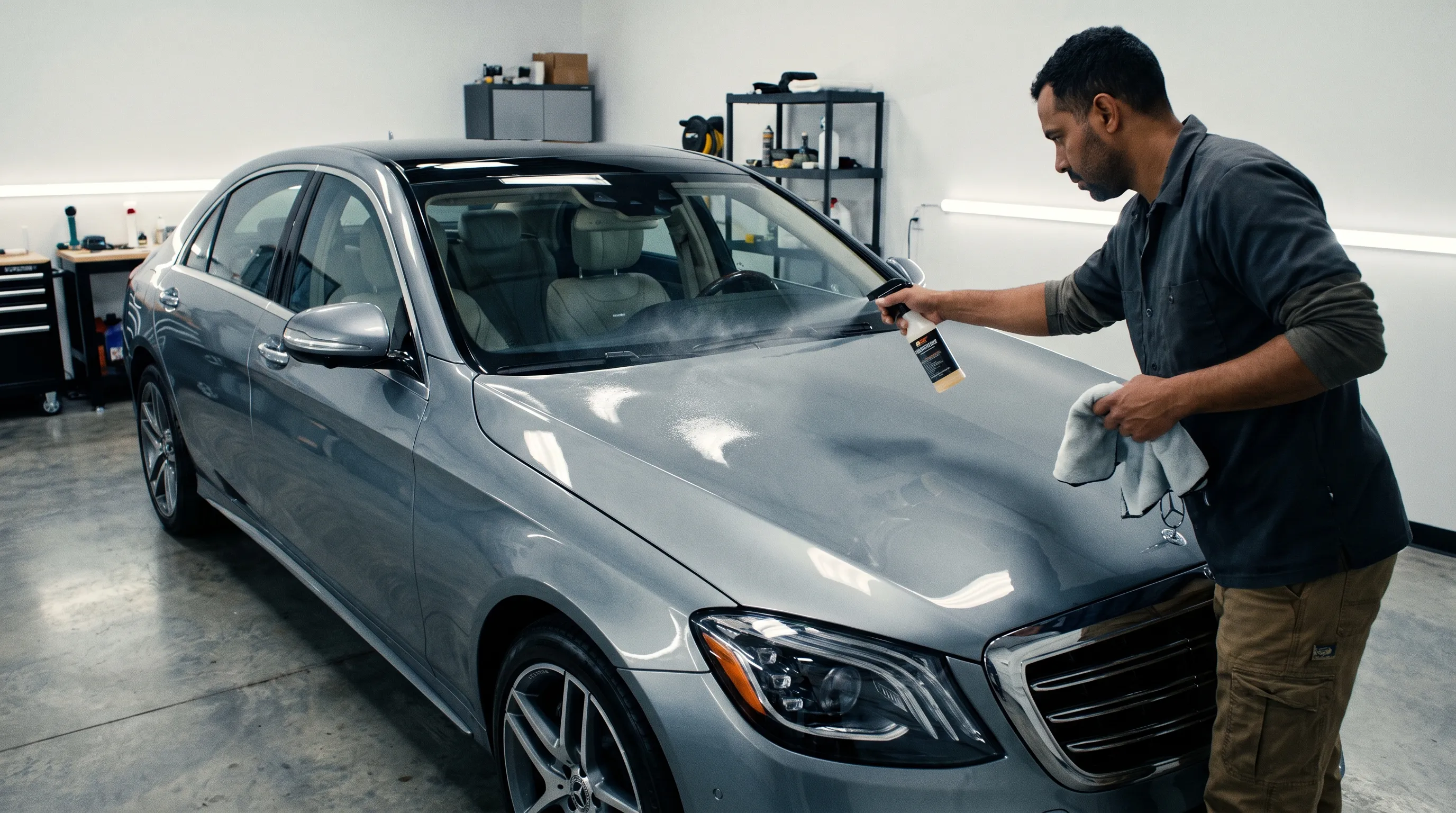
Hand washing gives the owner direct control over pressure, wash media, and the direction in which water moves across the film. It also allows lifted edges or impact damage to be identified before high-pressure water reaches them.
Wash the vehicle in shade or on a cool surface. Hot panels accelerate shampoo drying and increase the risk of mineral deposits, especially on a hydrophobic surface where water remains as individual beads.
Use this sequence:
- Inspect the PPF for lifted edges, punctures, loose seams, and heavy contamination.
- Rinse the vehicle thoroughly to remove loose sand and road grit.
- Apply a pH-appropriate automotive shampoo or compatible pre-wash.
- Wash using clean, soft microfiber or high-quality wash media.
- Move the wash media in controlled passes without scrubbing film edges.
- Rinse completely so detergent does not dry on the top coat.
- Dry with clean microfiber towels or filtered forced air.
- Inspect all edges after washing.
Begin with the cleanest upper panels and finish with the rockers, lower doors, bumpers, and wheel-impact zones. Using one contaminated mitt across the complete vehicle moves abrasive material from the lower body onto more visible panels.
Do not drag a dry towel across dusty PPF. Even a self-healing top coat can develop unnecessary marring when dry dust is trapped between the towel and film.
Remove bird droppings, insects, fuel, tree sap, and winter road residue promptly. Soften bonded contamination with approved cleaner or warm shampoo solution rather than increasing scrubbing pressure.
Every Crystal Shell automotive PPF model uses a hydrophobic functional surface. Water and contamination release more easily, but the vehicle still requires regular washing. The surface mechanism is explained in the hydrophobic PPF guide.
Can You Pressure Wash Paint Protection Film?
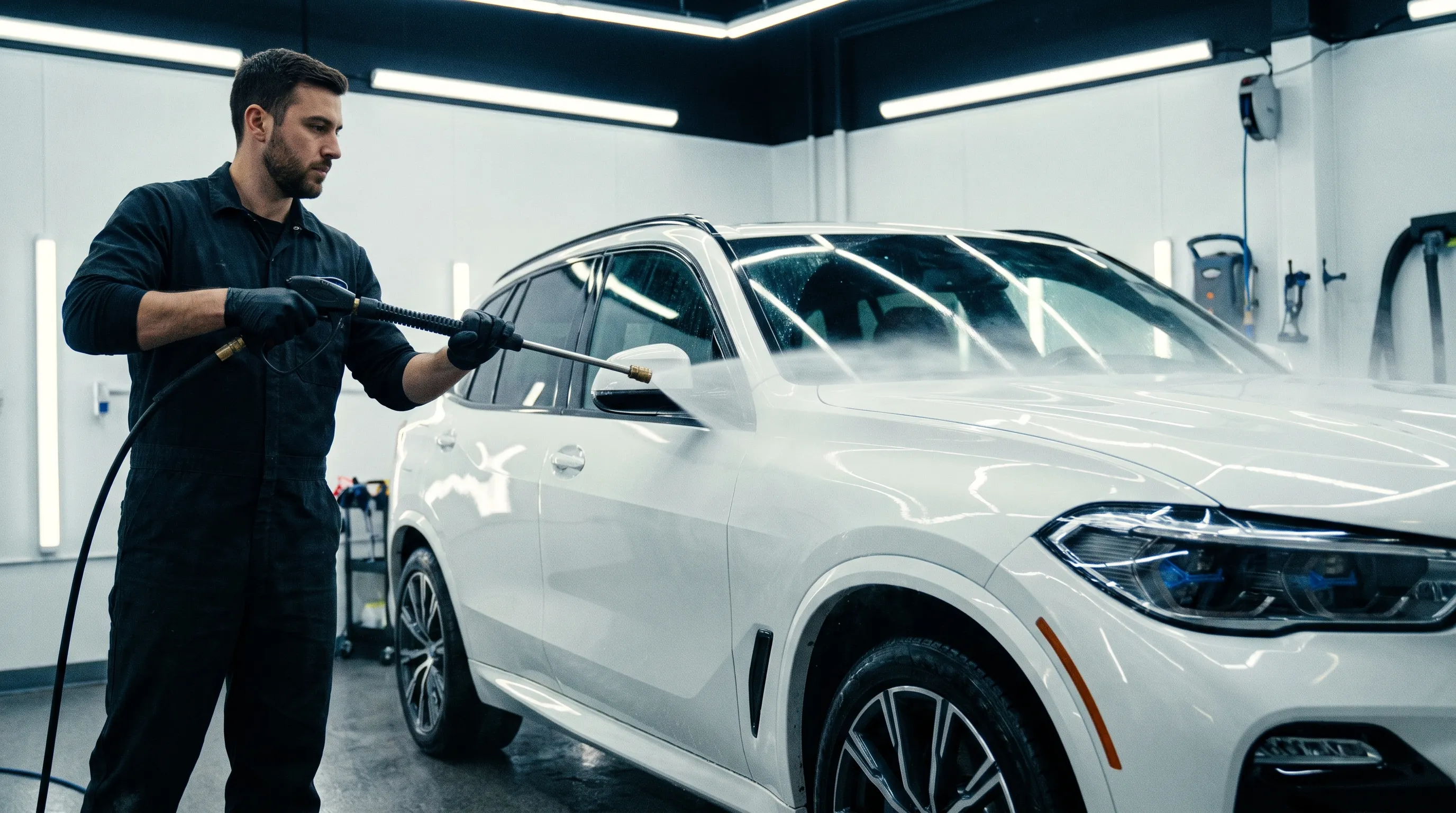
Yes, pressure washing PPF is possible after the initial curing period. The danger is not water pressure alone; it is concentrated pressure directed beneath an edge, seam, puncture, or section that has not developed stable adhesion.
Use conservative settings:
- Use a 40-degree or wider fan nozzle.
- Keep pressure at or below approximately 1,200 psi or 80 bar.
- Keep heated water at or below 60°C or 140°F.
- Hold the nozzle at least 30 cm or 12 inches from the film when spraying nearly perpendicular to the panel.
- Increase the distance when using a shallower spray angle.
- Never aim the stream into a film edge, seam, corner, or lifted section.
Move the spray across the panel rather than holding it in one place. Use the pressure washer to loosen and carry away contamination, not to cut dried insects or tar from the surface.
Pay particular attention to exposed pattern edges. A water jet approaching from the film side and moving off the edge is safer than a jet aimed from exposed paint toward the underside of the film.
Do not pressure wash damaged PPF. A stone puncture, cut, or lifted corner gives water direct access to the adhesive interface. The jet can enlarge the opening and drive contamination beneath the laminate.
Why Lower-Quality PPF Has Less Margin for Error
Pressure washing can damage any PPF when used incorrectly. Lower-quality film, inconsistent adhesive, poor coating control, damaged storage material, or badly prepared edges generally provide a narrower operating margin.
A weak adhesive may not build sufficient final bond around complex curves. An overly rigid carrier can store more recovery force at stretched edges, while inconsistent thickness can make one section behave differently from another.
The pressure washer does not create every failure from nothing. It often exposes an existing weakness: contaminated edge preparation, insufficient squeegee pressure, retained solution, excessive stretch, or unstable adhesive performance.
This is why a low-cost film can become expensive after installation. Saving a small amount on the roll loses value when the shop must re-anchor edges, replace a bumper pattern, or manage a customer callback after routine washing.
Crystal Premium Clear Bra is designed around predictable adhesive behavior, stable TPU recovery, and reliable edge performance. That provides a stronger installation foundation, but it does not justify aiming a high-pressure jet beneath the film.
Material quality and correct washing work together. Premium PPF reduces avoidable risk; responsible maintenance prevents the owner from creating new risk.
Can You Use a Brush on Self-Healing PPF?
A soft, clean detailing brush can be useful around badges, grilles, panel gaps, and textured trim. A rotating automatic-car-wash brush or stiff body brush should not be used as normal PPF wash media.
Brushes collect sand and grit. Once that contamination becomes trapped in the fibres, every rotation or scrubbing pass moves abrasive particles across the top coat.
Crystal Shell automotive PPF uses self-healing surface technology. If accidental light marring occurs, warmth and time can allow shallow marks in the functional surface to relax and become less visible.
That capability is valuable, but it has limits:
- It works best on shallow surface displacement.
- It does not remove embedded contamination.
- It does not rebuild a top coat removed by abrasion.
- It does not close deep cuts or punctures.
- It does not repair lifted edges caused by brush contact.
- It cannot restore matte texture that has been polished smooth.
A light accidental brush mark may fade after the panel warms in sunlight or receives controlled professional heat. Repeated brush washing can create thousands of overlapping marks faster than the surface can recover cleanly.
Automatic brush washes can also catch a loose edge and pull the film farther from the panel. Touchless washing is the safer automated option when hand washing is unavailable.
Do not market self-healing as permission to use poor wash technique. Its purpose is to preserve appearance after normal light wear—not make abrasive contact irrelevant.
The molecular recovery process is covered in the science of self-healing TPU.
Products and Techniques That Damage PPF
PPF should be maintained as a functional polyurethane surface, not treated as an unlimited layer of automotive clearcoat. The complete film may measure approximately 7.5 mil, but its functional top coat represents only a small portion of that thickness.
Avoid:
- Strong acidic or alkaline wheel cleaners on body film
- Brake cleaner, fuel, lacquer thinner, or unidentified solvents
- Abrasive cleaner waxes and rubbing compounds
- Scouring pads, melamine foam, or stiff brushes
- Dry wiping dusty panels
- Steam directed under PPF edges
- Pressure-washer turbo nozzles or narrow zero-degree tips
- Machine polishing matte or satin PPF
A mild PPF-safe chemical is usually preferable to aggressive mechanical scrubbing. Chemical dwell time allows contamination to soften while reducing the pressure required from the wash media.
Test unfamiliar chemicals on a spare film sample or concealed section. Look for swelling, haze, gloss change, darkening, staining, or reduced hydrophobic performance after the surface dries.
Do not assume that strong water beading proves the film is clean. Oily residue can also create temporary beading while trapping road film underneath it.
Dry the vehicle after rinsing, especially when the water contains high mineral levels. Hydrophobic PPF forms isolated droplets that can leave concentrated mineral rings if they evaporate on a hot hood or roof.
Maintaining Crystal Shell PPF
The Crystal Shell automotive range combines advanced aliphatic TPU technology developed by Lubrizol with hydrophobic and self-healing functional surfaces. The objective is easier maintenance, resistance to shallow marring, and stable long-term appearance.
Crystal Premium Clear Bra should be washed using soft media, suitable shampoo, and controlled drying. Its gloss top coat can recover fine surface marks, but abrasive compounds should not be used as routine maintenance.
Crystal Satin Stealth requires matte-compatible cleaning products. Conventional wax, gloss enhancers, aggressive polishing, or repeated brush contact can flatten the surface microtexture and create permanent bright patches.
Crystal Color Infused PPF uses the same protection-first approach across a broad range of colors and shades. Test strong cleaners before use because residue or chemical staining may appear differently across dark, light, metallic, and satin finishes.
For Crystal Shell installations, shops should give customers a clear post-installation protocol:
- Do not wash for at least 72 hours.
- Extend the waiting period toward seven days in cold or humid conditions.
- Use hand washing as the default method.
- Use touchless washing rather than automatic brushes.
- Keep pressure-washer spray away from every film edge.
- Return to the installer if an edge begins lifting.
- Photograph unexpected changes before attempting a repair.
Clean installation and maintenance equipment also reduce surface damage. Microfiber-safe squeegees, edge tools, and controlled accessories are available through Crystal Shell Precision Install Tools.
Owners interested in adding wax or ceramic protection should first review the PPF layering guide. Every Crystal Shell film is already hydrophobic, so additional coating is optional rather than required.
Conclusion: Clean the Film Without Attacking Its Edges
Wait at least 72 hours before washing newly installed PPF, and use a longer curing window when weather or installation conditions slow adhesive stabilization. Hand washing with soft, clean media remains the lowest-risk method.
A pressure washer can be used with a wide fan, controlled pressure, adequate distance, and a spray direction that never drives water beneath an edge. Lower-quality material and weak installation practices may fail sooner, but excessive pressure can damage any film.
Crystal Shell self-healing surfaces can reduce light accidental wash marring. They cannot make dirty brushes, stiff bristles, deep abrasion, or edge contact safe.
Review Crystal Premium Clear Bra, explore the complete Crystal Shell material platform, or contact Crystal Shell for product-specific maintenance and aftercare guidance.