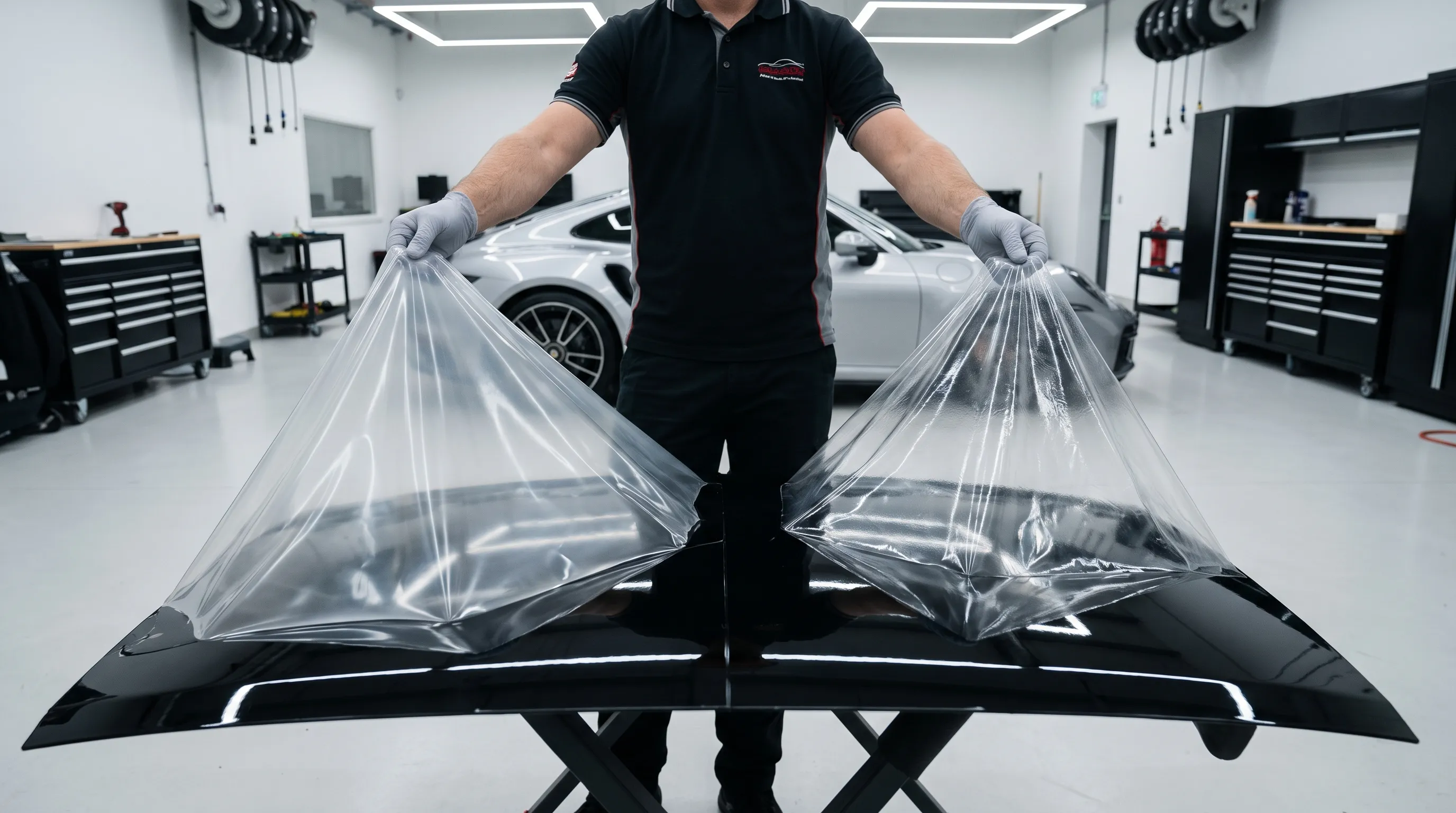
TPU vs. PVC PPF is not a minor material choice for Canadian installers. It determines how the film absorbs gravel impact, moves in cold weather, recovers from surface marks, maintains clarity, and behaves after repeated cycles of snow, road salt, freezing temperatures, and heated garage storage.
PVC is a legitimate material for vehicle graphics and color-change wraps. For protection-first applications, however, modern aliphatic TPU provides the elasticity, impact absorption, weatherability, and optical performance expected from premium paint protection film.
What Is the Difference Between TPU and PVC PPF?
TPU is thermoplastic polyurethane, a segmented elastomer built from flexible soft segments and more rigid hard segments. This structure allows the film to stretch under load, distribute impact energy, and recover toward its original shape after deformation.
PVC is polyvinyl chloride. In vehicle applications, it is commonly formulated with additives and plasticizers to create a flexible, conformable film suitable for graphics, branding, and exterior color changes.
Both materials can be transparent, coloured, adhesive-backed, and installed over automotive paint. That visual similarity causes low-cost PVC products to be marketed as PPF even when their construction and primary function are closer to vinyl wrap.
The intended job is the clearest dividing line. Vinyl wrap is primarily engineered to change colour or finish. TPU PPF is engineered to place a thicker, elastic, sacrificial barrier between road debris and factory clearcoat.
Many cast vinyl vehicle wraps use a face film approximately 3–5 mil thick, depending on colour, texture, and construction. A common premium automotive PPF construction is approximately 7.5 mil, or 190 microns, including adhesive.
Thickness alone does not make one film protective. A thick PVC sheet does not automatically gain the elasticity, tear resistance, surface recovery, or long-term optical stability of a properly engineered aliphatic TPU laminate.
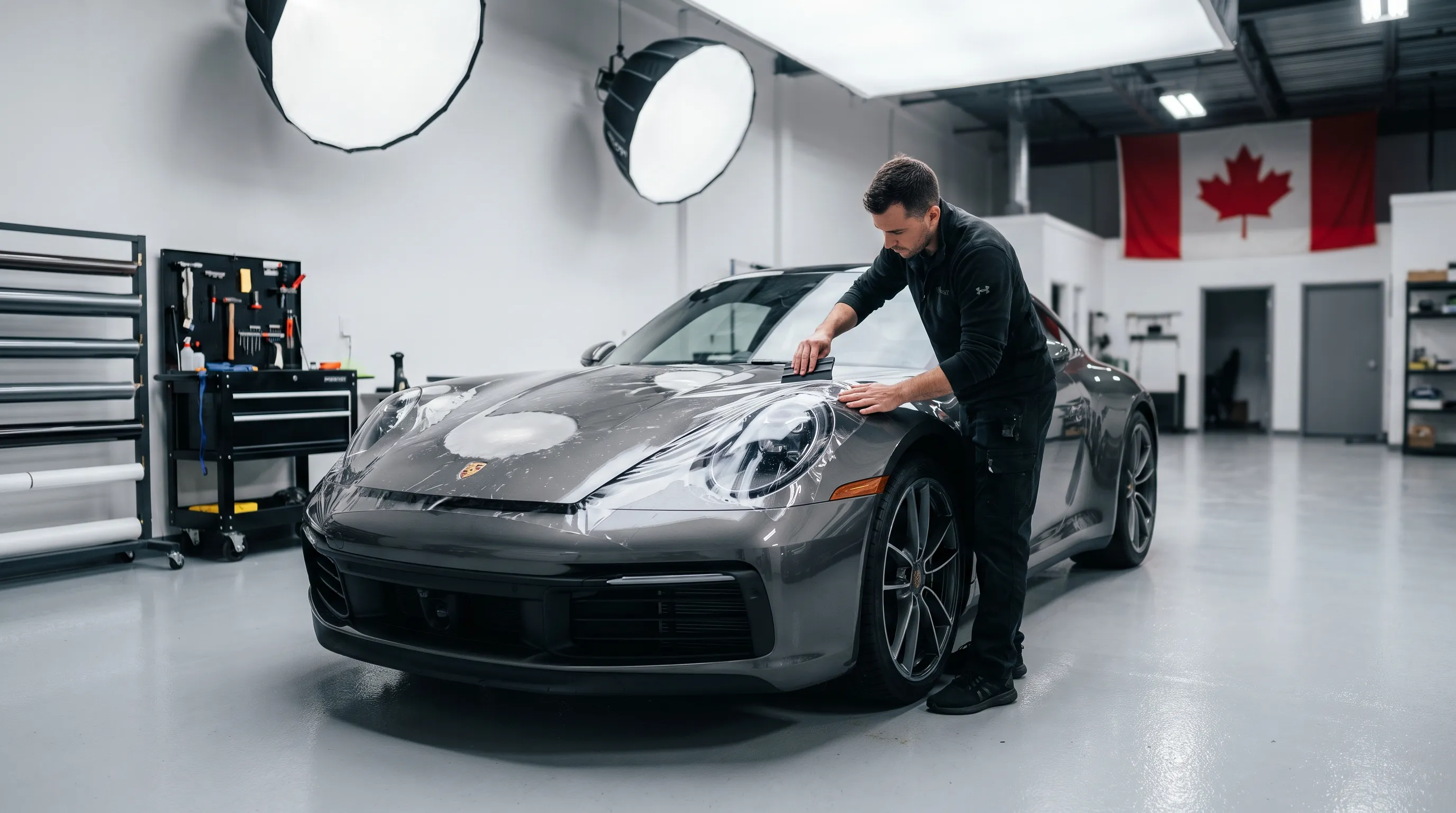
Why Canadian Conditions Expose the Material Difference
Canadian vehicles experience a combination of conditions that is harder on film than one laboratory temperature. A winter-driven car can move from a heated shop or underground garage into sub-zero air, then return covered in wet salt, snow, sand, and traffic film.
That repeated thermal cycling affects the face film, top coat, adhesive, wrapped edges, and areas installed under tension. Material that looks acceptable on a flat sample at 22°C may behave differently on a bumper corner in January.
Cold-Weather Flexibility
TPU is selected for applications that require elasticity across a broad temperature range. A quality aliphatic TPU PPF remains flexible enough to absorb small impacts rather than behaving like a rigid surface layer as temperatures fall.
Flexible PVC can also function in cold conditions, but its behaviour depends heavily on formulation and plasticization. As the material ages, a lower-grade construction may become stiffer, show greater shrinkage, or place more recovery force on stretched edges.
This does not mean installers should apply TPF in a freezing shop. The roll, vehicle, adhesive, slip solution, and installation room should be conditioned to the product’s specified application range.
For most professional installations, maintaining the room and panel near 20–24°C provides more predictable tack, stretch, squeegee response, and moisture evacuation. A film designed to survive Canadian cold still needs to be installed under controlled conditions.
Salt, Brine, and Winter Road Debris
Canadian road authorities use salt for de-icing and anti-icing throughout winter. The resulting brine combines with sand, gravel, iron contamination, oils, and frozen road debris before being sprayed against the vehicle.
PPF reduces direct contact between that mixture and the covered paint. The TPU layer absorbs part of the physical impact, while the functional top coat helps resist contamination and makes winter residue easier to remove.
This is where genuine PPF earns its price. The front bumper, hood, mirrors, rocker panels, lower doors, and rear wheel impact zones are exposed to both abrasive debris and chemical residue—not only UV radiation or cosmetic dirt.
PPF is not complete rustproofing. It does not protect suspension components, underbody seams, exposed fasteners, or metal behind trim. Canadian owners still need appropriate underbody corrosion protection and regular winter washing.
TPU vs. PVC PPF: Protection Performance
For installers, the useful question is not which film is easier to describe during a sales presentation. It is which material can provide measurable protection without creating avoidable callbacks, edge failures, optical complaints, or premature replacement.
| Performance factor | Aliphatic TPU PPF | PVC-based film |
|---|---|---|
| Primary purpose | Physical paint protection | Styling, graphics, or budget surface coverage |
| Stone-chip protection | Strong when thickness and construction are appropriate | Limited compared with premium TPU PPF |
| Elastic recovery | High material elasticity | More dependent on plasticizer and formulation |
| Cold-weather flexibility | Strong advantage for Canadian use | Can stiffen more noticeably in lower-grade constructions |
| Self-healing surface | Available through engineered functional top coats | Usually limited or cosmetic rather than true recovery |
| Optical clarity | Designed for transparent protection applications | Product-dependent; often optimized for colour rather than clarity |
| UV colour stability | Strong with color-stable aliphatic TPU | Depends heavily on stabilizers, pigments, and plasticizer system |
| Typical premium application | Clear, satin, or coloured protective coverage | Colour change, commercial graphics, and temporary styling |
TPU does not make a film indestructible. Large stones can puncture it, deep cuts cannot regenerate, and a poor adhesive can still lift from an edge. The advantage is that the complete material platform is better suited to absorbing and recovering from physical deformation.
Self-healing is another important distinction. In premium PPF, shallow surface marks can relax as heat increases polymer-chain mobility in the functional surface layer.
A PVC film may hide fine defects through gloss, texture, or heat-assisted surface movement, but that should not automatically be marketed as equivalent molecular recovery. The mechanism behind modern PPF is explained in the science of self-healing TPU.
Colour stability also needs precise language. Aliphatic TPU is selected for transparent outdoor applications because it resists UV-driven discoloration better than aromatic polyurethane and many lower-cost film constructions.
The difference becomes obvious on white, silver, pearl, and light blue vehicles. A small warm colour shift that remains hidden on black paint can become visible where a protected panel meets exposed paint.
What Canadian Installers Notice in the Shop
Material performance affects installation economics before it affects the customer’s vehicle. A lower roll price loses its advantage when the shop spends more time fighting stretch marks, adhesive disturbance, edge shrinkage, inconsistent gloss, or difficult cold-weather handling.
TPU PPF normally uses a wet installation method. The slip and tack solutions allow the installer to position a thicker protective film, remove trapped moisture, and manage tension across compound curves.
PVC colour wrap is commonly installed dry and uses air-release adhesive technology. That workflow is productive for styling, but it should not be treated as evidence that PVC provides the same impact protection as wet-applied PPF.
A Canadian installer should evaluate more than conformability on the day of installation. Test the film after it has been conditioned cold, returned to room temperature, stretched around a panel edge, and exposed to repeated wash and heat cycles.
Pay attention to:
- Clarity and adhesive distortion over black paint
- Recovery after shallow scratching at room temperature and controlled heat
- Edge stability after cold and warm thermal cycling
- Gloss or satin consistency in stretched areas
- Staining from road tar, iron residue, and winter traffic film
- Ability to reposition without creating stretch lines
- Removal behaviour from factory and repainted panels
Installation tools also influence the result. Damaged squeegee edges, uncontrolled blade depth, and improvised tuck tools can mark a top coat or damage paint regardless of the film’s chemistry.
Crystal Shell Precision Install Tools support the complete PPF workflow, including positioning, moisture evacuation, controlled trimming, edge work, and finishing around complex automotive geometry.
Why Crystal Shell Uses Aliphatic TPU
Crystal Shell is built around PPF rather than generic vehicle film. Its premium protection products use advanced aliphatic TPU technology developed by Lubrizol to improve cold-weather flexibility, abrasion resistance, optical stability, UV resistance, and long-term surface performance.
Lubrizol’s current-generation aliphatic TPU platform is designed for demanding transparent film applications. It is plasticizer-free and engineered to maintain flexibility across a broad temperature range without relying on the same plasticization strategy commonly associated with flexible PVC.
The TPU carrier is only the structural foundation. Crystal Shell combines it with a functional top coat and optically controlled pressure-sensitive adhesive to create a complete protective laminate.
Crystal Premium Clear Bra
Crystal Premium Clear Bra is the primary recommendation for Canadian customers who want to preserve the factory gloss finish. Its 7.5 mil-class construction is designed to protect high-impact panels from gravel, winter road debris, abrasion, insect residue, and repeated seasonal washing.
The transparent aliphatic TPU must perform two jobs at once: absorb impact without becoming excessively rigid in cold weather and remain optically neutral over light and dark paint colours.
For most Canadian daily drivers, installers should begin with the complete front bumper, hood, front fenders, and mirror caps. Rocker panels, lower doors, A-pillars, roof leading edges, and rear wheel impact zones can be added according to mileage and road conditions.
Crystal Satin Stealth and Color Infused PPF
Crystal Satin Stealth gives installers a protective alternative to a cosmetic matte vinyl conversion. It changes the vehicle’s finish while retaining the thicker TPU barrier required for stone-chip and abrasion protection.
This is commercially important. A customer asking for a satin vehicle does not need to choose between style and meaningful paint protection.
Crystal Color Infused PPF extends the same principle to coloured film. It combines a visual transformation with TPU-based impact protection, giving installers a higher-value option than presenting conventional vinyl colour change as a protective product.
PVC wrap still has a valid role when the customer’s priority is temporary branding, broad colour selection, or a lower-cost styling change. Crystal Shell PPF should be positioned where preserving paint condition and reducing physical damage are the primary objectives.
The complete material architecture is described on the Crystal Shell technology platform. Canadian shops interested in product access, training, and professional support can apply through the Crystal Shell dealer program.
Conclusion: Sell Protection, Not Film Thickness
TPU vs. PVC PPF is ultimately a comparison of intended function. PVC is an effective vehicle-wrap material when the job is colour, graphics, or temporary styling. Aliphatic TPU is the stronger platform when the customer is paying to protect factory paint from Canadian gravel, salt spray, abrasion, thermal cycling, and long-term outdoor exposure.
Do not sell TPU only as a more expensive type of plastic. Sell the behaviours the customer receives: cold-weather flexibility, impact absorption, surface recovery, optical clarity, stain resistance, and a removable sacrificial layer over the paint.
For clear protection, start with Crystal Premium Clear Bra. For protective satin or colour conversion, compare Crystal Satin Stealth and Crystal Color Infused PPF, or contact Crystal Shell to build a Canadian-market installation package.