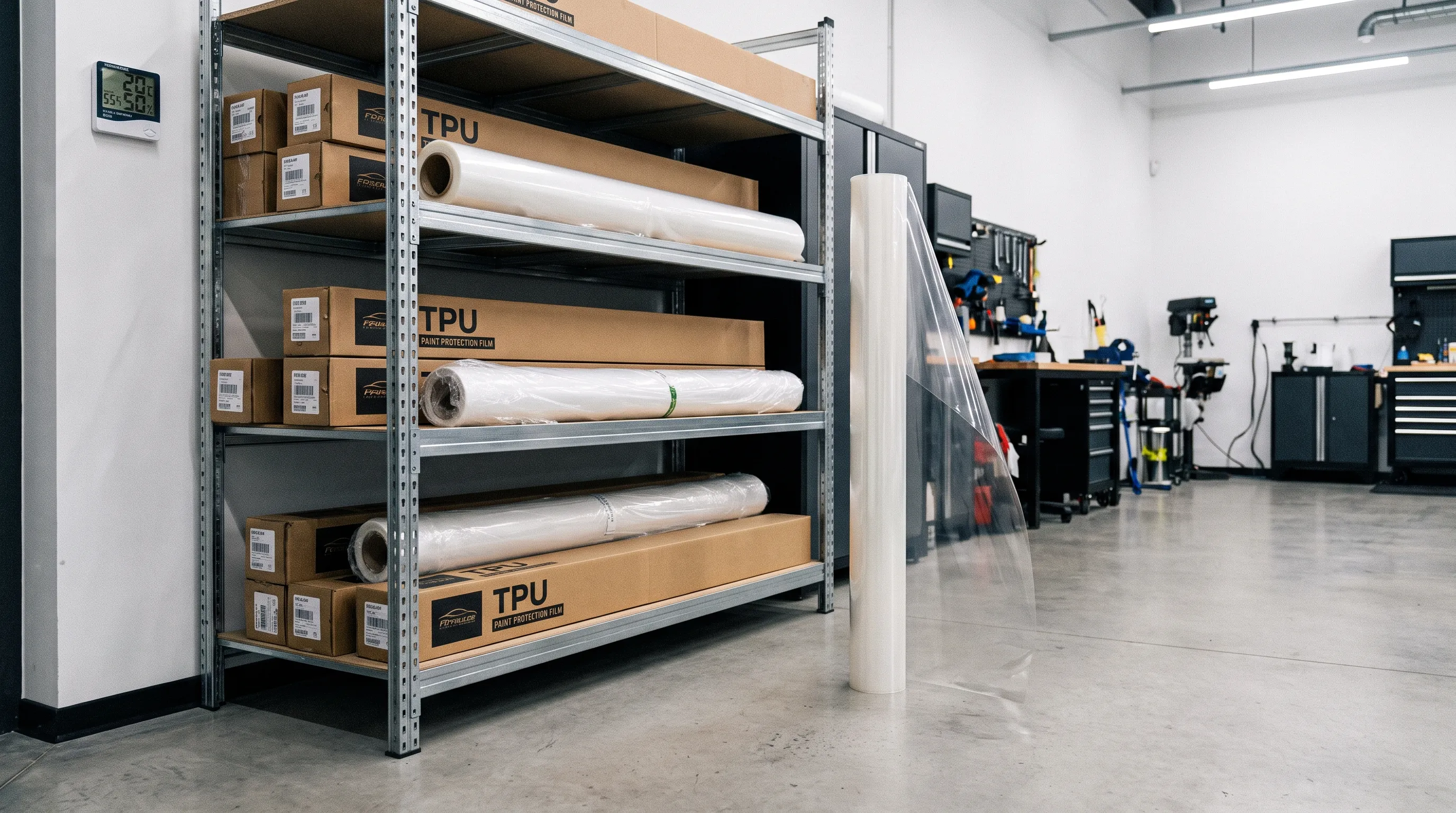
How to store PPF rolls correctly comes down to four controls: stable room temperature, moderate humidity, protection from sunlight, and support that prevents pressure damage. A premium roll can be compromised before installation if it is left in a hot van, placed on a damp floor, or opened while still cold from transport.
PPF may tolerate extreme temperatures after installation, but storage is a different condition. Inside the carton, the TPU, top coat, pressure-sensitive adhesive, cap sheet, and release liner remain compressed together for weeks or months.
Why PPF Storage Conditions Matter
Paint protection film is not a single sheet of plastic. It is a controlled laminate in which every layer must retain its dimensions, surface quality, and release behavior until installation.
Excessive heat can accelerate adhesive flow, increase blocking between layers, distort the roll, and allow the material to telescope sideways around the core. Prolonged heat can also increase liner curl and make release behavior less predictable.
Cold storage creates a different problem. TPU and adhesive become temporarily stiffer, while the release liner may resist flattening. Opening and pulling cold film can create tunneling, liner separation, sharp creases, or unnecessary stress at the roll edge.
Humidity affects the paper or polymer release liner, static behavior, and the risk of condensation. High humidity can introduce dimensional changes and moisture around the roll, while excessively dry air increases static attraction and contamination during unrolling.
Storage damage may not be obvious from the outside of the carton. The first signs can appear during plotting or installation:
- The roll does not lie flat on the cutting table.
- The liner curls or separates unevenly.
- The adhesive appears more aggressive in one section.
- Edges show pressure marks, dents, or permanent waves.
- The film telescopes to one side of the core.
- Gloss or top-coat texture changes near a crushed edge.
- Moisture appears inside the packaging after opening.
Installers often blame these symptoms on film formulation. Before opening a material claim, verify the shipment temperature, warehouse conditions, carton orientation, and how long the roll was allowed to acclimate.
The Correct Temperature and Humidity for PPF
A practical controlled-storage target for professional PPF inventory is 20–23°C or 68–73°F with 45–55% relative humidity. Minor short-term movement outside that range is less concerning than repeated daily temperature swings or prolonged exposure to heat and moisture.
Always follow the product-specific technical data sheet when it defines a narrower range. Storage, application, and service temperatures describe different conditions and should not be treated as interchangeable specifications.
Storage Temperature
Keep unopened and partial rolls in a clean climate-controlled room. Do not store PPF beside a heater, boiler, compressor exhaust, curing lamp, exterior metal wall, or window receiving direct sunlight.
Avoid using a vehicle as temporary inventory storage. A closed van or car can reach temperatures far above the surrounding air, creating concentrated heat around one side of the carton.
Cold warehouse storage is less likely to create immediate chemical degradation, but the film must return gradually to installation temperature before opening. A roll that has spent the night below freezing should not move directly from the delivery truck to the plotter.
A film may have a published service range extending below −30°C after installation. That does not mean a tightly wound, frozen roll can be unboxed, flexed, and installed safely at the same temperature.
Relative Humidity
Keep relative humidity near 50% when possible. A controlled range of approximately 45–55% limits static without exposing the carton, liner, or core to persistent moisture.
Do not place cartons directly on a concrete floor. Concrete can remain cooler than the room, collect condensation, and transfer moisture into cardboard packaging.
Raise inventory on shelving or pallets and leave airflow around the cartons. Keep it away from wash bays, floor drains, steam-cleaning equipment, open doors, and areas where vehicles enter covered in snow or rain.
A dehumidifier can control a damp storage room, but it should not blow hot, dry air directly onto the rolls. The objective is stable room conditions, not rapid local drying.
| Storage factor | Recommended shop target | Main risk outside the range |
|---|---|---|
| Temperature | 20–23°C or 68–73°F | Adhesive flow, stiffness, roll distortion, or liner curl |
| Relative humidity | 45–55% | Condensation, liner movement, static, or contamination |
| Sunlight | No direct exposure | Localized heating and premature material aging |
| Packaging | Original sealed carton | Dust, pressure damage, moisture, and unidentified inventory |
| Floor contact | Store on raised shelving | Moisture transfer and carton damage |
How to Position and Protect PPF Rolls
Keep rolls in their original cartons until they are required. The carton protects the film from UV exposure, dust, accidental contact, and pressure from nearby tools or inventory.
Store the cartons in the orientation specified by the film supplier. For Crystal Shell inventory, use an upright supported position with the core aligned vertically, unless a product-specific shipping label states otherwise.
The bottom surface must be flat and clean. Do not balance a roll on a damaged carton corner or allow the weight to rest on the exposed edge of the film.
Avoid stacking heavy cartons on top of PPF. Concentrated pressure can deform the cardboard core, create flat spots, or print a repeating pressure line into multiple layers of tightly wound film.
Partial rolls require more protection than sealed inventory. Rewind the film evenly without pulling it excessively tight, secure it with a non-marking band, replace the protective bag, and return it to a labeled carton.
Do not apply ordinary masking tape directly to the top coat or adhesive edge. Tape residue and localized pressure can create defects that become visible only after installation.
Every partial roll should be labeled with:
- Product name and finish
- Batch or lot number
- Original roll width and remaining length
- Date first opened
- Storage location
- Any observed shipping or edge damage
Use first-in, first-out inventory rotation. A new carton should not be opened while older material from the same product remains unidentified at the back of the storage rack.
Keep knives, metal rulers, spray bottles, and heavy tools away from stored rolls. Equipment from Crystal Shell Precision Install Tools should have a dedicated workstation rather than being placed on film cartons between jobs.
How to Receive and Acclimate a Cold or Hot Roll
Inspect every shipment before signing it into inventory. Photograph the carton, shipping label, corners, core area, and any crushed, wet, pierced, or compressed sections.
If the carton is damaged, do not immediately remove all packaging. Record the condition first so the shop can distinguish transport damage from defects discovered after handling.
Move the roll into the controlled storage room while keeping the packaging sealed. The sealed carton slows temperature change and reduces the chance of warm humid air condensing directly on a cold film surface.
Allow a cold or overheated full roll to reach room temperature before opening. A practical acclimation period is commonly 12–24 hours, with additional time for a roll received after prolonged freezing or extreme summer heat.
Do not accelerate conditioning with a heat gun, infrared lamp, radiator, or heated floor. Rapid local heating creates a temperature gradient through the roll: the outer layers soften while the material near the core remains cold.
Before loading the plotter, check that:
- The carton and inner bag are dry.
- The roll has reached a stable room temperature.
- The core remains round and centered.
- The film has not telescoped sideways.
- The edges are clean and free from compression damage.
- The cap sheet and liner remain uniformly attached.
Unroll the first section slowly on a clean table. If it retains severe curl, shows liner tunneling, or produces condensation, stop and allow additional conditioning rather than forcing the material through a plotter.
The Crystal Shell Storage Protocol
Crystal Shell PPF uses advanced aliphatic TPU technology developed by Lubrizol, but raw polymer quality does not eliminate the need for controlled roll handling. The finished product also contains a functional top coat, adhesive, cap sheet, liner, and wound-roll structure that must remain stable until installation.
For Crystal Premium Clear Bra, Crystal Satin Stealth, and Crystal Color Infused PPF, shops should follow the same baseline controls:
- Receive and photograph each unopened shipment.
- Record the batch number and arrival date.
- Store the sealed carton near 20–23°C and 45–55% RH.
- Keep the roll raised, shaded, clean, and free from stacked weight.
- Acclimate the sealed roll before opening after hot or cold transport.
- Relabel and protect every partial roll immediately after use.
- Report physical damage before cutting material from the affected area.
Crystal Shell’s internal shipped-product records show a reported defect and return rate below 0.01%. The limited recorded cases have predominantly involved physical damage associated with transportation or improper storage rather than chemical failure of film installed on vehicles.
That low rate does not make storage damage unimportant. It shows that the remaining preventable failures are concentrated in logistics and handling—the period between the production line and the installation bay.
A roll crushed during transport cannot be restored by good TPU chemistry. A contaminated edge cannot be corrected by a ten-year warranty, and a film opened while covered in condensation should not be placed on a customer vehicle.
Installers should preserve the carton, batch label, delivery photographs, and damaged sample when submitting a claim. Clear documentation allows Crystal Shell to separate transport damage, storage damage, installation error, and qualifying manufacturing defects.
The complete material construction is explained on the Crystal Shell technology platform. Shops requiring product, storage, or warranty guidance can use the Crystal Shell dealer program or contact Crystal Shell.
Conclusion: Protect the Roll Before It Reaches the Vehicle
Correct PPF storage is not complicated: maintain stable room conditions, keep humidity near 50%, block sunlight, preserve the original packaging, prevent pressure damage, and let every shipment acclimate before opening.
The expensive mistakes happen when shops treat a tightly wound laminate like an ordinary sheet of plastic. Heat affects adhesive behavior, cold increases temporary stiffness, humidity affects packaging and liners, and careless stacking can physically damage multiple metres of film at once.
Protect the inventory with the same discipline used during installation. Start with Crystal Premium Clear Bra, standardize handling with Crystal Shell Precision Install Tools, and document every roll from delivery through final installation.