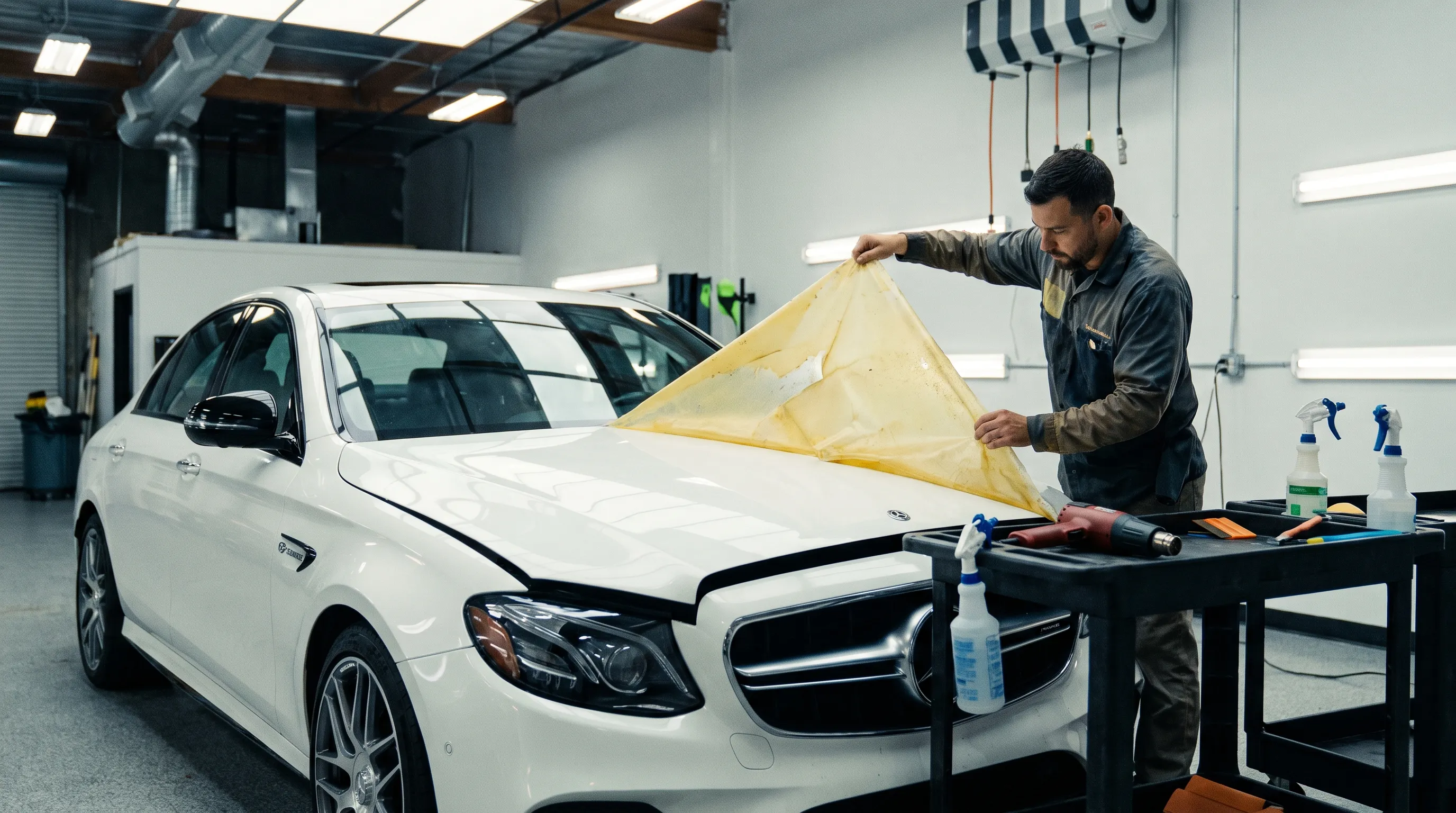
Why does cheap PPF turn yellow? The usual causes are lower-grade polymer chemistry, insufficient UV stabilization, an unstable top coat, adhesive discoloration, or poor control of the complete laminate. The same cost reductions that shorten optical life can also make the film slower and less predictable to install.
Saving $200 on material sounds rational until the film adds three hours to the job, lifts from a bumper edge, or returns six months later for replacement. Installers should compare total installed cost—not the amount printed on the roll invoice.
Why Does Cheap PPF Turn Yellow?
Clear PPF has an unforgiving job. It must remain optically neutral while receiving UV radiation, heat, moisture, detergents, road chemicals, abrasion, and repeated mechanical strain.
A lower price does not prove that a film will yellow. It does increase the need to verify which TPU, top coat, adhesive, stabilizers, and manufacturing controls were used to reach that price.
Aromatic and Aliphatic TPU Are Not Equivalent
Thermoplastic polyurethane can be produced with aromatic or aliphatic isocyanate chemistry. Both materials may initially appear clear, flexible, and difficult to distinguish on a fresh sample.
The difference emerges under UV exposure. Aromatic structures can photo-oxidize and form chromophores—chemical structures that absorb visible light and create a yellow or amber appearance.
UV absorbers can delay this process, but stabilizing an aromatic TPU does not turn it into aliphatic TPU. The yellowing pathway remains inside the molecular structure.
Premium transparent PPF therefore uses color-stable aliphatic TPU. The material is more expensive, but it provides a stronger foundation for outdoor optical clarity, weatherability, elasticity, and long-term appearance.
This does not mean that every film labeled “aliphatic TPU” is equal. Resin grade, extrusion temperature, film uniformity, additive dispersion, top-coat compatibility, and storage conditions can still separate a stable film from a problematic one.
The TPU Is Not Always the Layer That Failed
PPF is a multilayer product. Visible yellowing can originate in the TPU carrier, functional top coat, pressure-sensitive adhesive, or contamination accumulated on the outer surface.
A weak top coat may oxidize, retain road dye, absorb hydrocarbons, or become porous. The installer sees a yellow or cloudy panel even if the TPU beneath remains relatively stable.
Adhesive can also produce a warm color shift below the film. Oxidation, inconsistent coating weight, contamination during lamination, or poor compatibility between adhesive and TPU may become visible first on white and pearl paint.
Edge yellowing is often a different problem. Exposed adhesive can collect polishing compound, wax, road oil, dust, and detergent residue. Cleaning may improve the appearance, but a poorly finished edge will continue collecting contamination.
The chemistry behind color stability is covered in more detail in how modern TPU resists PPF yellowing.
Why Cheap PPF Is Often Harder to Install
Yellowing is a long-term failure. Installers often discover the first cost problem before the vehicle leaves the shop.
Budget film may have a narrower installation window. Small changes in room temperature, solution ratio, panel temperature, or stretch can produce a large change in tack and repositioning behavior.
Common shop problems include:
- Adhesive that grabs before the pattern is aligned
- Adhesive that remains weak around wrapped edges
- Inconsistent release-liner separation
- Glue lines or silvering after repositioning
- Excessive top-coat friction under the squeegee
- Stretch marks that remain visible on dark paint
- Uneven thickness or texture across the roll
- Edge lift after moisture and heat cycling
These failures are not caused by “cheapness” as a chemical property. They usually indicate that the manufacturer reduced formulation cost, coating precision, quality-control frequency, or production tolerance.
Adhesive behavior is particularly expensive. An overly aggressive adhesive limits repositioning and increases the risk of distortion. An adhesive with inadequate initial or final peel strength may install comfortably but lift later from corners and wrapped returns.
The target is controlled tack: enough movement for accurate placement, enough response to pressure for clean anchoring, and sufficient final adhesion after the moisture leaves the laminate.
Film uniformity matters as well. A variation that looks small on a technical sheet can create different stretch, texture, and squeegee behavior across a bumper pattern. The technician slows down because the material stops responding consistently.
Premium material does not remove the need for skill. It gives the technician a wider, more repeatable process window in which that skill can produce the intended result.
How a $200 Saving Turns Into a Four-Figure Loss
Roll price is easy to measure. Lost production capacity is easier to ignore because it appears as another hour in the installation bay rather than a separate supplier invoice.
The more useful calculation is:
Total installed cost = material + installation labor + rework + replacement film + warranty labor + customer recovery.
Consider an illustrative shop comparison. A lower-cost film saves $200 on the material required for a full-front installation.
If the material adds three technician-hours through difficult alignment, repeated lifting, edge correction, and extended inspection, the saving is already gone at an internal shop-hour value of $75. Three hours represent $225 of production capacity.
| Cost event | Illustrative internal impact |
|---|---|
| Initial material saving | +$200 |
| Three additional installation hours at $75 | −$225 |
| One bumper reinstallation: four hours | −$300 before replacement material |
| Replacement film, cleaning, and consumables | −$150 to −$300 |
| Missed installation slot or discounted customer recovery | Shop-dependent |
One callback can convert the original $200 saving into a $475–$625 internal loss before accounting for scheduling disruption. A full-front or full-body replacement can push the loss into four figures.
The batch-level calculation is worse. If a difficult film adds one hour to 20 installations, the shop loses 20 sellable hours. At $75 per hour, that is $1,500 in capacity consumed by material behavior.
Add two warranty replacements requiring eight hours each, and another $1,200 of labor is gone before replacement film, removal, cleaning, and customer transport are counted.
The exact numbers will differ by market. The mechanism does not: a small material saving becomes expensive when multiplied by technician time and failure frequency.
What Better PPF Changes in the Installation Bay
A better film should not be defined only by how it looks on delivery day. It should reduce variance throughout positioning, stretching, squeegeeing, wrapping, curing, inspection, and long-term service.
For the installer, that means predictable liner release, controlled adhesive tack, clean moisture evacuation, uniform stretch, stable texture, and edges that remain attached after the vehicle leaves the controlled shop environment.
For the business, it means more accurate scheduling. A full-front package that consistently requires the planned labor is more profitable than a cheaper film that occasionally turns a one-day job into a two-day correction.
Predictability also reduces technician fatigue. Material that must be lifted repeatedly increases adhesive disturbance, contamination risk, physical strain, and the chance of a blade or tool mistake near the paint.
Tools cannot correct weak film chemistry, but they remove unnecessary process variation. Clean squeegee edges, controlled knives, reliable tuck tools, and consistent solution equipment help the installer evaluate the film rather than fight the equipment.
Crystal Shell Precision Install Tools are designed around positioning, moisture evacuation, edge finishing, and controlled trimming for professional PPF workflows.
How Crystal Shell Reduces Total Installed Cost
Crystal Shell is positioned around total installation efficiency rather than the lowest possible roll price. The objective is to give professional shops a film that produces reliable protection without consuming margin through avoidable installation resistance or callbacks.
Crystal Premium Clear Bra uses advanced color-stable aliphatic TPU technology developed by Lubrizol as the structural foundation of its 7.5 mil-class protective laminate.
The aliphatic TPU supports UV stability, optical clarity, elasticity, abrasion resistance, and recovery from deformation. Crystal Shell combines that carrier with a functional top coat and optically controlled pressure-sensitive adhesive.
In the installation bay, the practical targets are straightforward:
- Predictable initial tack without uncontrolled grabbing
- Clean repositioning during pattern alignment
- Efficient squeegee movement and moisture evacuation
- Controlled stretch over bumpers and compound curves
- Stable wrapped edges after thermal cycling
- Consistent clarity and texture across the installed panel
- Reduced probability of yellowing-related warranty work
This is a more credible value proposition than claiming the film installs itself. A skilled technician is still responsible for preparation, pattern strategy, tension control, edge cleaning, trimming, and final inspection.
Crystal Shell’s role is to make material behavior more repeatable so technician skill is spent producing a cleaner installation—not compensating for inconsistent film.
The full material architecture is explained on the Crystal Shell technology platform. Shops evaluating supply and technical support can also review the Crystal Shell dealer program.
How Installers Should Evaluate a Lower-Cost Film
Do not reject a film because its purchase price is low. Reject it when the supplier cannot prove what was removed from the product or process to achieve that price.
Run a controlled test before committing customer vehicles:
- Install identical samples over black, white, and metallic painted panels.
- Measure face-film, adhesive, and total laminate thickness separately.
- Record installation time rather than relying on technician memory.
- Compare initial tack, repositionability, and final edge adhesion.
- Stretch samples over compound curves and inspect texture change.
- Perform heat, moisture, detergent, stain, and cold-cycle testing.
- Request xenon-arc or QUV data with measured color change and haze.
- Review the warranty definition, labor coverage, and claim procedure.
Peel-adhesion results should include the test method, substrate, angle, dwell time, temperature, and aging condition. One isolated adhesion number cannot describe initial tack, repositioning, final bond, edge stability, and clean removal.
Also inspect consistency between rolls. A good sample followed by an unstable production batch exposes weak process control rather than a technician problem.
Factory-direct sourcing can reduce channel markup, but it does not automatically create better PPF. The supplier must still fund resin quality, coating control, inspection, batch traceability, technical support, and warranty administration.
That distinction is covered in the factory-direct PPF guide and the 7.5 mil PPF standard guide.
Conclusion: Buy for the Completed Installation
Cheap PPF turns yellow when the manufacturer compromises the polymer, stabilizer package, top coat, adhesive, or production control required for long-term optical stability. The same compromises can appear earlier as difficult positioning, inconsistent tack, stretch distortion, and unstable edges.
A $200 material saving is not a saving when it consumes $225 in extra installation time. It becomes a serious loss when one callback requires removal, cleaning, replacement film, another installation slot, and customer recovery.
Judge PPF by total installed cost: how quickly it produces a clean result, how consistently it behaves between rolls, and how rarely the vehicle returns for material-related correction.
Review Crystal Premium Clear Bra for a color-stable aliphatic TPU protection system, use Crystal Shell Precision Install Tools to standardize the installation process, or contact Crystal Shell to evaluate film for your shop.