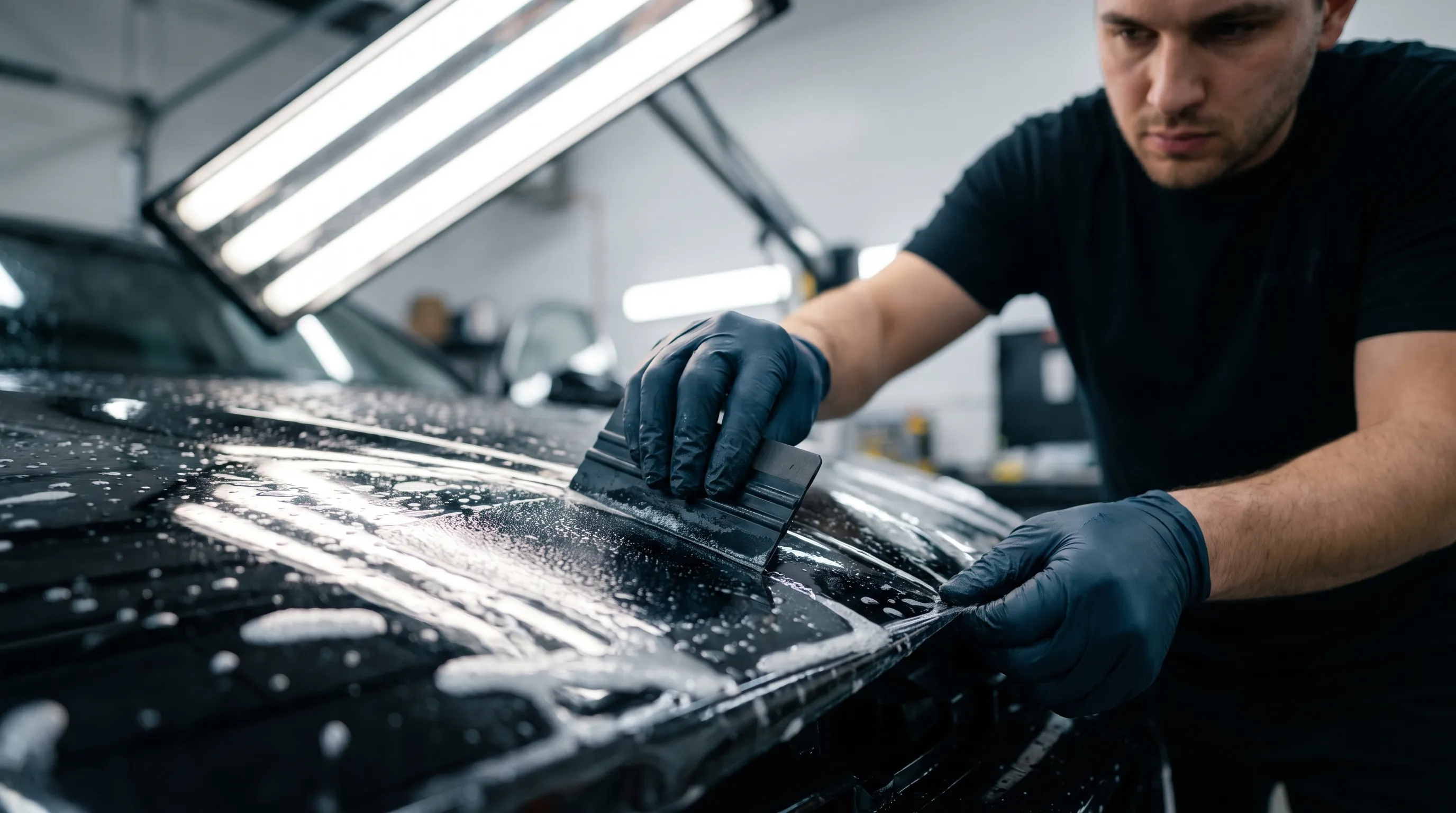
7.5 mil paint protection film has become one of the most common specifications in the automotive PPF market. That does not make it an official engineering standard, and it does not prove that two films carrying the same number will perform the same way.
The useful question is not whether a film says 7.5 mil on the box. It is what that measurement includes, how consistently the factory controls it, and whether the rest of the construction can survive years of impact, UV exposure, washing, heat, and installation stress.
What Does 7.5 Mil Paint Protection Film Mean?
A mil is one-thousandth of an inch, not one millimeter. A nominal thickness of 7.5 mil equals 0.0075 inch, approximately 0.1905 mm or 190.5 microns.
That conversion is straightforward. The industry's labeling practices are not.
A PPF construction normally includes a functional top coat, an aliphatic polyurethane carrier film, and a pressure-sensitive acrylic adhesive. A removable PET cap sheet may protect the gloss surface during transport, while a release liner protects the adhesive before installation.
The cap sheet and release liner are removed. They should never be counted as part of the protection installed on the vehicle.
Some technical data sheets report the polyurethane face film separately from the adhesive. Others publish one combined "film thickness" value without clearly explaining whether the adhesive is included.
For example, a construction may use a 6.0–6.5 mil polyurethane face with approximately 1.0–1.5 mil of adhesive. The installed laminate then measures near 7.5–8.0 mil even though the structural TPU layer itself is thinner than the headline number.
This distinction changes purchasing decisions. Two products described as 7.5 mil may contain different amounts of TPU, different adhesive thicknesses, and top coats with different hardness, stain resistance, and recovery behavior.
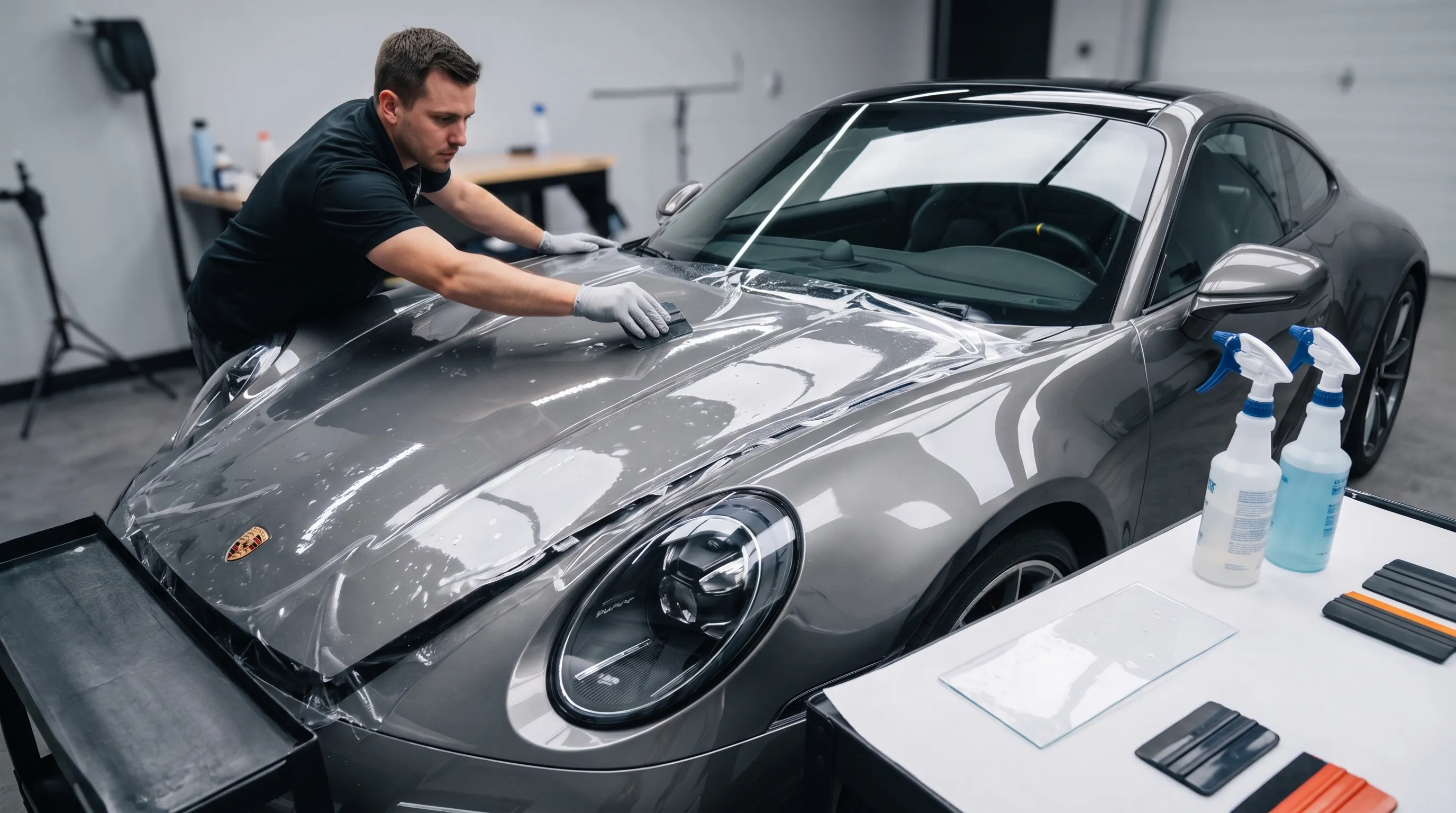
Why 7.5 Mil Became a Market Standard
No universal regulation requires automotive PPF to be 7.5 mil thick. Major manufacturers currently publish clear and colored films across a wider range, including approximately 7.5, 7.9, 8.0, 8.5, 10, and 12 mil.
Seven-and-a-half mil became common because it represents a practical engineering compromise. It provides enough material to deform under everyday gravel and abrasion while remaining manageable on bumpers, mirrors, fenders, and other compound curves.
Protection Without Excessive Bulk
Impact protection depends on the film's ability to absorb and redistribute energy before the object reaches the paint. Thickness contributes to that process, but TPU modulus, elongation, tear resistance, temperature, impact shape, and adhesive support also affect the result.
A sharp piece of gravel striking at highway speed creates a different failure mode from a rounded stone moving at lower speed. No responsible manufacturer should promise that a nominal thickness makes paint completely chip-proof.
The film is a sacrificial layer. Its job is to reduce the probability and severity of paint damage, not make the vehicle immune to physics.
Conformability on Complex Panels
Installers need enough elongation to form the material without creating haze, texture distortion, lift lines, or excessive edge tension. A moderate construction near 7.5–8.0 mil generally offers a useful balance between impact absorption and conformability.
Thicker films can be valuable on rocker panels, off-road vehicles, track cars, wheel arches, and other high-impact zones. The trade-off is greater material stiffness and more difficult forming around deep recesses or tight three-dimensional geometry.
An extra-thick film that must be overstretched to fit a bumper may perform worse at the edges than a thinner film installed within its intended strain range. Protection on the center of a test panel means little if the material lifts from the vehicle after one hot summer.
Is Thicker Paint Protection Film Better?
Thicker PPF can absorb more impact energy when the material chemistry and construction remain comparable. That qualification matters because thickness alone cannot identify the stronger product.
A poorly stabilized 10 mil film can yellow, crack, retain stains, or develop adhesive failure before a well-engineered 7.5 mil film. More material does not correct weak polymer formulation or inconsistent coating control.
| Nominal thickness class | Typical application | Main trade-off |
|---|---|---|
| Approximately 7–8 mil | Daily drivers, full-body installations, complex bumpers | Balanced protection and conformability |
| Approximately 8.5–10 mil | Track use, off-road vehicles, rockers, high-impact areas | More bulk and greater forming difficulty |
| Approximately 12 mil | Specialized heavy-duty or targeted protection | Reduced flexibility on complex automotive panels |
The better comparison starts with complete construction data. Evaluate the face-film thickness, adhesive thickness, TPU type, top-coat chemistry, tensile strength, elongation at break, stain testing, UV exposure, peel adhesion, and dimensional stability.
Impact testing also needs a repeatable method. SAE J400, for example, defines a laboratory procedure for evaluating coating resistance to gravel chipping. A key, wire brush, or air-powered stone demonstration may look dramatic, but it is not controlled enough for meaningful product comparison.
Hydrophobicity and self-healing should also remain separate from thickness. A 10 mil film is not automatically more stain resistant, and a 7.5 mil film is not automatically faster to heal.
Those behaviors are controlled primarily by the outer surface chemistry. The molecular mechanism is explained in the science of self-healing TPU.
What Cutting the Middleman Actually Changes
The conventional PPF supply chain may include a polymer or coating factory, private-label brand, regional importer, national distributor, local reseller, and installer. Every layer requires warehousing, sales support, credit management, marketing, logistics, and margin.
A factory-direct model can shorten that chain. It may reduce duplicated handling, regional markups, inventory aging, and the distance between production feedback and installer feedback.
That is the potential advantage. It is not proof of quality.
Costs That Can Be Removed
Direct purchasing can eliminate several commercial steps between production and installation. Fewer transfers can also make batch tracking easier and reduce the chance that rolls spend excessive time in uncontrolled storage.
The savings should appear as better material, stronger technical support, more competitive installer economics, or some combination of the three. A "factory-direct" label that produces no measurable customer benefit is only positioning.
Buyers should also reject unsupported percentage claims. Without a published channel structure, freight terms, warranty cost, and order volume, statements such as "50% less because there is no middleman" cannot be verified.
Responsibilities That Cannot Be Removed
Distributors do more than add margin. Strong distributors maintain local inventory, replace damaged rolls, manage warranty claims, provide training, extend credit, and help installers solve application problems.
Removing the distributor does not remove those responsibilities. It transfers them to the manufacturer, brand, installer, or customer.
A credible factory-direct supplier must therefore provide accessible technical documentation, reliable stock, batch traceability, installation support, sample material, warranty administration, and a clear replacement process. Without those systems, the lower purchase price may create a higher operating cost.
Crystal Shell's manufacturing and supply philosophy is outlined on the About Crystal Shell page and in the related article on factory-direct PPF sourcing. Installers evaluating dealership access can also review the Crystal Shell dealer program.
How to Evaluate Factory-Direct PPF
Factory-direct buying works only when technical transparency replaces channel reputation. The supplier should be willing to define exactly what is being manufactured, measured, tested, and warrantied.
Technical Documentation
Request a technical data sheet that separates face-film thickness from adhesive thickness. It should state whether the published 7.5 mil figure is a nominal value, an average, or a controlled specification range.
Look for named test methods rather than isolated numbers. "400% elongation" has limited value without the specimen geometry, test speed, conditioning temperature, and applicable ASTM or ISO method.
A serious evaluation should cover:
- Nominal face-film, adhesive, and total installed thickness
- Permitted thickness tolerance across the roll width
- Aliphatic TPU identification and top-coat construction
- Tensile strength and elongation with named test methods
- Peel adhesion, dimensional stability, and edge behavior
- Gravel-chip or impact testing under controlled conditions
- Xenon-arc, UV, humidity, and thermal-aging results
- Stain resistance against insects, oils, dyes, and road chemicals
- Batch numbers, manufacturing dates, and storage requirements
- Written warranty coverage and claim procedure
A ten-year warranty is not a laboratory result. It is a commercial commitment that matters only if the responsible company remains reachable, defines covered failures, and processes valid claims without pushing every defect onto the installer.
Practical Installer Testing
Installers should verify samples before ordering production volume. Remove the release liner and cap sheet, then measure the installed construction at several points with a low-force thickness gauge that will not compress the soft polyurethane.
Apply the material to black painted test panels. Black exposes adhesive disturbance, haze, stretch marks, top-coat texture, contamination, and edge defects faster than light paint.
Test flat sections and compound curves. Record initial tack, repositioning behavior, squeegee response, edge adhesion after 24 hours, gloss consistency, and surface change after controlled stretching.
Repeat stain and recovery tests after the sample has aged. A fresh roll can perform well because its surface is clean and its polymer remains highly mobile; the meaningful question is how it behaves after UV exposure, detergent cycles, heat, and contamination.
Installation tools also affect the result. A damaged squeegee edge can leave marks that are incorrectly blamed on the top coat, while an uncontrolled slip solution can distort adhesive evaluation. Standardize the process with equipment from Precision Install Tools.
For product-level construction and application details, review the Crystal Shell technology platform and Crystal Premium Clear Bra. Technical questions should be resolved through Crystal Shell support before a full roll is committed to a customer vehicle.
Conclusion: Measure the Film, Then Judge the Supply Chain
Seven-and-a-half mil is a proven, practical thickness class for automotive PPF, but it is not a universal certificate of quality. The number must be interpreted alongside TPU formulation, adhesive design, top-coat performance, manufacturing tolerance, testing, and installation behavior.
Factory-direct sourcing can remove unnecessary channel cost and shorten the feedback loop between installers and production. It succeeds only when the supplier also replaces the technical support, inventory control, traceability, and warranty functions previously handled by distributors.
Do not buy the thickest number or the shortest supply-chain diagram. Measure the sample, inspect the documentation, test the material on real geometry, and then compare Crystal Premium Clear Bra with the requirements of your installation business or vehicle.